

close
Choose Your Site
Global
Social Media
Views: 0 Author: Site Editor Publish Time: 2026-06-30 Origin: Site


Cosmetic chemists face a constant formulation dilemma. You need a sustainable, naturally derived conditioning agent. It must perform comparably to synthetic silicones and polyquaterniums. However, it cannot compromise formulation stability. Finding this balance is rarely easy. Traditional biopolymers often fail under commercial manufacturing conditions. Enter the hydroxypropyl modification. This specific chemical shift transforms rigid, pH-dependent chitosan into a highly soluble, versatile biopolymer.
We will evaluate the functional viability of this modified ingredient. Our objective is to examine its role as a primary film former and structural adhesive in commercial hair care systems. Readers will learn how this ingredient overcomes traditional solubility hurdles. You will also discover practical ways to integrate it into modern shampoos, masks, and styling gels without unwanted precipitation.
Water Solubility: Hydroxypropyl modification resolves the notorious solubility limitations of raw chitosan, enabling broader pH compatibility in aqueous formulations.
Dual-Action Performance: Acts as both a flexible hair care film former and a structural conditioning polymer, reducing cuticle friction and preventing moisture loss.
Formulation Integration: Offers high compatibility with non-ionic and cationic surfactants, though formulators must carefully manage anionic systems to prevent precipitation.
Procurement Viability: Available in both traditional crustacean and emerging vegan (mushroom-derived) sources, allowing brands to align with specific compliance and marketing mandates.
Consumer and regulatory pressures are reshaping hair care chemistry. Shoppers actively reject cyclic silicones. They also avoid certain synthetic cationic polymers. These legacy ingredients often persist in the environment. They also cause heavy buildup on the scalp over time. Brands want clean-label alternatives. However, replacing polyquaterniums with natural options usually reduces product performance. Hair feels less smooth. Frizz control drops significantly in humid conditions.
Standard chitosan seemed like a natural solution. It offers excellent film-forming properties. Yet, unmodified chitosan creates massive formulation headaches. It is extremely difficult to scale in commercial hair care. Raw chitosan requires an acidic environment to dissolve. Formulators must use lactic or acetic acid to force it into solution. Once the pH approaches neutral, standard chitosan becomes unstable. It crashes out of the formula. This poor stability ruins clear shampoos and lightweight gels.
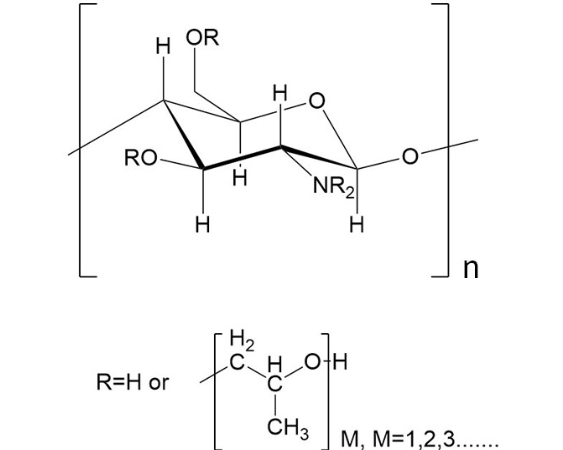
The hydroxypropyl modification solves this core problem. Chemists introduce hydroxypropyl groups to the chitosan backbone. This etherification process creates critical steric hindrance. It disrupts the tight intermolecular hydrogen bonding. The result is a highly water-soluble derivative. It is completely ready for cosmetic application. You no longer need aggressive pH manipulation. The biopolymer dissolves easily in water at room temperature. This single chemical change unlocks the ingredient for widespread commercial use.
Not all modified biopolymers suit cosmetic use. Material specification requirements dictate formulation success. You must evaluate purity, deacetylation degree, and molecular weight distribution. High purity prevents unwanted color shifts in clear formulas. The deacetylation degree controls the cationic charge density. A higher degree usually means better substantive properties. Consistent molecular weight distribution ensures reliable viscosity batch after batch.
Structural adhesion is a major benefit here. Hair damage exposes internal proteins. Bleaching, styling, and UV exposure strip the protective lipid layer. This damage creates negatively charged cysteic acid sites along the keratin shaft. The cationic nature of the polymer interacts directly with these sites. It binds electrostatically to the most damaged areas. This targeted adhesion smooths rough patches without coating healthy hair heavily.
Barrier formation defines the sensory experience. Heavy silicones seal the hair but weigh it down. Hydroxypropyl Chitosan Cosmetic Grade acts differently. It creates a permeable, non-tacky matrix. This shield protects against environmental stressors like pollution and dry air. Yet, it allows the hair to breathe. Fine hair retains its natural volume. The film resists flaking, keeping hair soft and manageable all day.
Evaluating this biopolymer requires a close look at its primary functions. We must break down its performance into three core dimensions. This helps R&D teams benchmark it against synthetic industry standards.
Synthetic alternatives like PVP often create brittle films. They hold style but cause flaking. This modified biopolymer acts as a flexible hair care film former. It bends with the hair fiber. This flexibility significantly improves curl retention. It also delivers exceptional anti-frizz performance. The polymer wraps the cuticle in a continuous shield. This provides mild thermal protection during blow-drying. The flexible nature ensures the hair feels naturally soft, never stiff.
Lifted cuticles cause friction. They make hair difficult to comb and prone to breakage. The mechanics of this polymer focus on bridging these lifted cuticles. Evidence shows it physically glues down raised keratin scales. This structural repair reduces combing force instantly. You will notice significant improvements in both wet and dry combing tests. The hair strands glide past each other. This reduces mechanical damage during daily grooming routines.
Moisture retention determines long-term hair health. As a structural conditioning polymer, its hygroscopicity is impressive. It binds moisture tightly to the hair shaft. How does it compare to standard humectants?
| Ingredient | Moisture Retention Function | High-Humidity Performance | Hair Feel |
|---|---|---|---|
| Hydroxypropyl Chitosan | Creates a breathable film trapping moisture inside the cortex. | Excellent anti-frizz. Resists swelling in damp air. | Weightless, smooth, non-tacky. |
| Hyaluronic Acid | Draws water to the surface of the hair shaft. | Can cause frizz if environmental moisture is too high. | Soft but can feel limp on fine hair. |
| Standard Panthenol | Penetrates the cortex to increase internal hydration. | Moderate. Does not provide strong exterior film holding. | Slightly heavier, good for thick hair. |
This table highlights its superiority in high-humidity environments. It prevents excessive swelling of the hair shaft. This keeps the cuticle flat and reflects light for high shine.
Theoretical benefits mean little if the ingredient fails in the lab. Formulators must understand specific implementation realities to avoid unstable batches.
Dissolution is straightforward but requires care. Add the powder slowly to the water phase. Maintain a temperature between 25°C and 40°C. Cold water works, but warm water accelerates hydration. Use medium sheer mixing. High sheer can sometimes degrade the polymer chains. Wait until the solution is completely clear before adding subsequent ingredients.
Surfactant selection dictates product stability. This is a cationic-leaning amphoteric material. You must observe strict compatibility rules:
Green Flag: Non-ionic surfactants (like decyl glucoside) and amphoteric systems (like cocamidopropyl betaine) work perfectly. Cationic emulsifiers also show excellent compatibility.
Red Flag/Risk: Anionic surfactants require extreme caution. Mixing this polymer directly with strong anionics (like SLS or SLES) invites trouble. Mismanaging the ratios leads to immediate precipitation. You will see a stringy, coacervate mess at the bottom of your beaker.
The versatility of this ingredient allows for broad application. Formulators utilize specific hydroxypropyl chitosan uses across various product categories. Clear styling gels benefit from its flake-free hold. Leave-in conditioners rely on its wet-combing slip. Repairing hair masks use it to bridge damaged cuticles. Scalp serums incorporate it to soothe irritation without blocking follicles.
Formulators should follow precise concentration ranges. Your target viscosity and desired film thickness dictate the exact percentage.
Daily Shampoos (0.1% - 0.3%): Provides light conditioning. Reduces wash-induced cuticle friction.
Leave-in Conditioners (0.3% - 0.6%): Delivers noticeable slip. Protects against thermal styling damage.
Hair Masks (0.5% - 1.0%): Maximizes structural repair. Creates a denser protective matrix for highly porous hair.
Styling Gels (0.8% - 1.5%): Acts as a primary hold agent. Replaces synthetic PVP for natural curl retention.
Procurement teams face their own set of challenges. Securing a reliable supply chain requires strict shortlisting logic.
Purchasing teams must demand comprehensive documentation. Always request detailed Certificates of Analysis (COA). Look closely at heavy metal testing. Natural marine derivatives can carry trace contaminants if poorly processed. Demand proof of molecular weight consistency. Inconsistent batches will wreck your formulation's viscosity. Reliable suppliers will provide tightly controlled specifications.
The market is shifting rapidly. Historically, suppliers derived raw chitosan from crustacean shells. This poses an issue for vegan brands. Today, fungal sources are changing the landscape. Mushroom-derived cosmetic chitosan offers a 100% vegan alternative. You must evaluate the cost-to-marketing-benefit ratio. Fungal variants typically cost more per kilogram. However, they allow brands to claim "cruelty-free" and "vegan" on packaging. This premium positioning often justifies the raw material cost for indie and prestige brands.
Raw material inventory management is crucial. This modified biopolymer boasts excellent shelf stability. Store it in a cool, dry place away from direct sunlight. Keep the containers tightly sealed to prevent moisture absorption. Under proper conditions, the powder remains stable for 24 to 36 months. Expected degradation curves show minimal loss of molecular weight during this period.
Hydroxypropyl chitosan is not a mythical miracle ingredient. It is a highly functional, structurally sound bridge. It connects the demand for natural ingredient mandates with the need for high-performance cosmetic chemistry. It provides exceptional film-forming and conditioning benefits without the heavy buildup of legacy synthetics.
Consider these next-step actions for your formulation team:
Request samples from suppliers offering both marine and vegan variants to test solubility.
Review your formulation guides meticulously regarding anionic surfactant compatibility to avoid unexpected precipitation.
Benchmark the material in a blind wet-comb test against your current polyquaternium load.
Experiment with low usage rates (0.2%) in existing clear formulas to evaluate immediate sensory upgrades.
A: No. It is important to dispel this consumer myth. While it improves overall scalp health and significantly reduces hair breakage via structural support, it does not stimulate the follicle. It is not a clinically proven hair regrowth active like minoxidil. It simply helps you retain the hair you have by preventing mechanical damage.
A: It entirely depends on the source. Traditional versions are crustacean-derived, utilizing shrimp or crab shells. However, modern commercial suppliers now offer 100% vegan, mushroom-derived variants. Buyers must explicitly specify the vegan requirement during procurement and verify it via supplier documentation.
A: It can replace silicones for lightweight conditioning, volume retention, and anti-frizz claims. However, it may lack the extreme initial slip of heavy dimethicones. To fully replicate that high-slip sensory feel, formulators often blend it with natural plant oils or hemisqualane.


