

close
Choose Your Site
Global
Social Media
Views: 0 Author: Site Editor Publish Time: 2026-08-10 Origin: Site


Viscosity dictates the functional performance of polymer-based excipients in modern drug delivery systems. When formulating with functionalized biopolymers, selecting an incorrect viscosity grade introduces immediate formulation risks. These errors cause compromised Active Pharmaceutical Ingredient (API) release kinetics, poor syringeability in parenteral applications, and severe manufacturing bottlenecks from unexpected shear-thickening or shear-thinning during scale-up operations.
Formulators need a systematic framework to evaluate and specify the exact viscosity range for carboxymethyl chitosan. You cannot guess these parameters. You must align them with target dosage forms, processing constraints, environmental sensitivities, and regulatory requirements. By mapping macroscopic flow behavior against microscopic chain dynamics, development teams can engineer scalable and compliant pharmaceutical products.
The apparent viscosity of any polymer solution is a macroscopic manifestation of its microscopic molecular weight and chain entanglements. In aqueous solutions, the empirical relationship between the molecular weight of the chitosan backbone and its viscosity follows the Mark-Houwink equation. As the molecular weight increases, the polymer chains become longer, leading to a higher degree of physical entanglement. This entanglement restricts the flow of the solvent molecules, increasing the measured viscosity. If you increase the average molecular weight slightly, you will see an exponential jump in solution viscosity, which drastically alters the handling characteristics of the excipient.
Beyond molecular weight, the degree of carboxymethylation determines the hydrodynamic volume of the polymer. When carboxymethyl groups attach to the polymer backbone, they impart a negative charge under specific pH conditions. This structural modification forces the polymer chains to repel one another. The chains uncoil and occupy a larger hydrodynamic volume in the solvent. A higher degree of substitution leads to a more extended chain conformation, increasing the apparent viscosity even if the baseline molecular weight remains constant.
Balancing the molecular weight with the degree of substitution is the first necessary step in selecting the appropriate grade from the available pharmaceutical chitosan derivatives. Formulators must request detailed specifications from suppliers that list both parameters, as two batches with identical molecular weights can exhibit vastly different flow behaviors if their substitution levels vary.
Carboxymethyl chitosan exhibits an amphoteric nature, containing both basic amino groups and acidic carboxyl groups. This dual functionality means its rheological behavior is highly sensitive to the pH of the surrounding environment. At specific pH thresholds, the ionization state of these functional groups shifts. When you formulate near the isoelectric point, the polymer chains coil tightly due to intramolecular electrostatic interactions. This causes a distinct drop in apparent viscosity. Moving away from the isoelectric point causes the chains to uncoil due to electrostatic repulsion, leading to a swollen conformation and a corresponding spike in viscosity.
You must map the pH profile of your intended dosage form to anticipate these drastic rheological shifts. If a liquid formulation experiences a pH drift during its shelf life, the viscosity will change, potentially causing suspended particles to settle or emulsions to break. Buffer selection becomes a primary engineering control to lock the pH and stabilize the polymer conformation.
Equally important is the polyelectrolyte effect driven by the ionic strength of the formulation buffer. The presence of salts, such as sodium chloride, impacts the electrical double layer surrounding the polymer chains. High ionic strength shields the electrostatic charges on the polymer backbone. Without the repulsive forces keeping the chains extended, the polymer collapses into a compact, coiled structure. This suppression of the electrical double layer invariably leads to a substantial loss of viscosity. Evaluating the target viscosity must always account for the final salt concentration of the formulation to prevent unexpected thinning during compounding.
Proper excipient selection requires benchmarking against other modified biopolymers to ensure the chosen material aligns with the specific functional requirements of the dosage form. Carboxymethyl chitosan provides excellent aqueous solubility across a broad pH range and potent mucoadhesive properties. This makes it ideal for mucosal drug delivery and liquid formulations. However, its viscosity profile remains highly sensitive to ionic environments, which limits its use in high-salt buffer systems.
In contrast, hydroxypropyl chitosan is preferred when the formulation demands superior film-forming capabilities and enhanced solubility in mixed aqueous-organic solvent systems. Its non-ionic nature makes its viscosity profile far more stable in the presence of electrolytes. On the other hand, succinyl chitosan provides distinct pH-responsive behaviors. Formulators use it in targeted intestinal delivery systems where the polymer remains intact in the acidic gastric environment but swells and releases the API in the neutral pH of the intestines.
Derivative Functional Comparison
| Derivative Type | Primary Functional Advantage | Rheological Stability in High Salt | Ideal Application |
|---|---|---|---|
| Carboxymethyl | Amphoteric solubility, strong mucoadhesion | Low (susceptible to polyelectrolyte effect) | Mucosal delivery, liquid suspensions |
| Hydroxypropyl | Film-forming, mixed solvent solubility | High (non-ionic nature) | Topical films, transdermal patches |
| Succinyl | pH-responsive swelling | Moderate | Enteric coatings, targeted intestinal delivery |
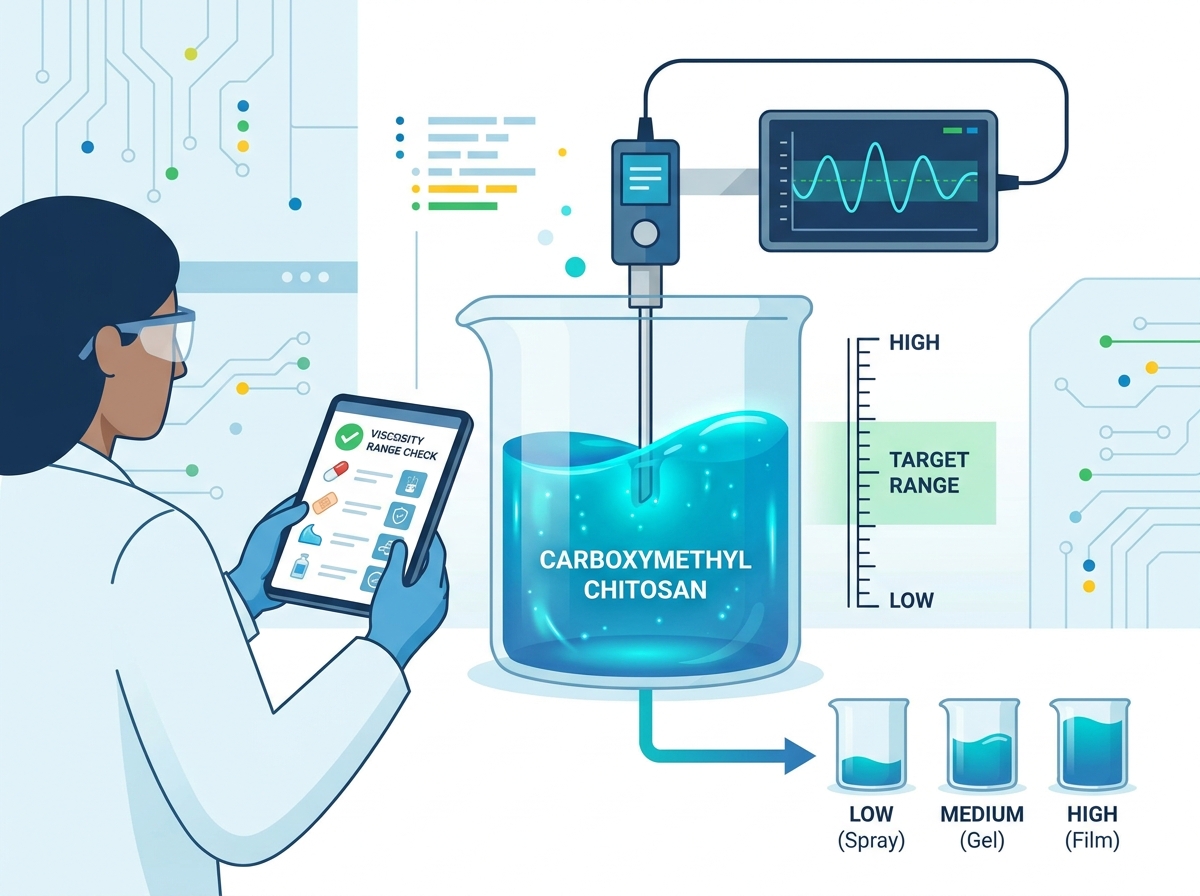
For parenteral and mucosal applications, low-viscosity grades are mandatory. In injectable formulations, the primary rheological constraint is syringeability. This is the force required to expel the liquid through a fine-gauge needle, typically 27G or 30G. If the viscosity exceeds 100 mPa·s, the injection becomes painful for the patient and difficult for the healthcare provider to administer. The Hagen-Poiseuille equation dictates that flow rate through a needle is inversely proportional to fluid viscosity, making low-viscosity selection a non-negotiable parameter for injectables.
For nasal or topical sprays, a low-viscosity profile ensures the liquid atomizes efficiently. High viscosity prevents the spray nozzle from breaking the fluid stream into fine droplets, resulting in a solid jet of liquid rather than a mist. Low viscosity produces a consistent droplet size distribution for precise dosing through standard spray pumps.
In ophthalmic solutions, low viscosity strikes a delicate balance between extending the corneal residence time and maintaining patient comfort. A slight increase in viscosity helps the API adhere to the ocular surface. However, excessive thickness leads to blurred vision and reflex tearing, which rapidly washes away the active ingredient. A critical success factor for these low-viscosity grades in parenteral routes is the strict control of endotoxin levels. The manufacturing processes must ensure the final excipient is highly purified and pyrogen-free, typically requiring endotoxin limits below 0.1 EU/mg.
Medium-viscosity grades serve as the foundation for semi-solid formulations and solid oral dosage forms. In topical gels, creams, and emulsions, achieving the desired spreadability and structural integrity relies heavily on this specific viscosity band. The polymer network must stabilize suspended particles or emulsified oil droplets, preventing phase separation over the product's shelf life. It must remain fluid enough to shear-thin upon application, allowing the patient to rub the formulation smoothly into the skin without leaving a tacky residue.
Medium-viscosity grades are highly effective as wet granulation binders in tablet manufacturing. During granulation, the polymer solution acts as a liquid bridge, agglomerating fine powder particles into uniform granules. The viscosity must provide strong inter-particulate bonds, which optimizes final tablet hardness and reduces friability. If the viscosity is too high, the binder solution cannot spray evenly over the powder bed, leading to localized over-wetting and inconsistent granule growth.
To optimize wet granulation with medium-viscosity grades, formulators follow specific operational steps:
When the formulation objective shifts to controlling the release rate of highly soluble APIs, high-viscosity grades become essential. In sustained-release matrix tablets, the polymer rapidly hydrates upon contact with gastrointestinal fluids to form a robust, viscous gel layer around the solid core. This gel layer acts as a physical barrier. It controls the diffusion rate of the dissolved drug outward and the penetration rate of water inward. High-viscosity polymers excel in forming these dense hydrogel networks, preventing premature disintegration of the tablet and mitigating the risk of dose dumping.
The success criteria for utilizing these high-viscosity grades focus on achieving predictable release kinetics. Formulators engineer systems that deliver zero-order release, where the drug releases at a constant rate independent of concentration. They may also target predictable first-order release over extended periods, typically 12 to 24 hours. The structural integrity of the hydrogel determines the tortuosity and porosity of the diffusion pathways.
Selecting a grade with insufficient viscosity results in a weak gel layer. This weak layer erodes too quickly under the mechanical shear of gastric motility, failing the sustained-release objective. Formulators test these matrices using USP Apparatus 1 or 2, setting paddle speeds between 50 and 100 RPM to simulate the hydrodynamic shear of the human gastrointestinal tract.
Viscosity Grade Selection Guide
| Viscosity Range (mPa·s) | Target Dosage Forms | Primary Rheological Function | Processing Considerations |
|---|---|---|---|
| <100 | Injectables, Ophthalmics, Sprays | Syringeability, Spreadability, Atomization | Requires strict low endotoxin and bioburden limits. |
| 100 – 500 | Topical Gels, Emulsions, Tablet Binders | Structural integrity, Wet granulation binding | Moderate shear required for complete hydration without clumping. |
| >500 | Sustained-Release Matrices, Hydrogels | Diffusion control, Robust gel network formation | High risk of shear degradation during pumping; requires specialized impellers. |
The integration of the Pharmaceutical Excipient Chitosan Series into a formulation directly dictates the rate of polymer hydration and subsequent gel layer formation. When a solid dosage form contacts an aqueous medium, the outer surface of the polymer transitions from a glassy state to a rubbery state. The viscosity of the chosen grade determines the density and mechanical strength of this rubbery gel layer. A high-viscosity polymer creates a highly entangled, restrictive matrix that slows the diffusion of water into the tablet core and retards the outward migration of the API.
Formulators rely on evidence-based parameters for testing dissolution profiles. Testing involves multiple dissolution media representing different physiological pH environments, such as pH 1.2 for gastric fluid and pH 6.8 for intestinal fluid. This assesses how the amphoteric nature of the polymer interacts with its inherent viscosity. Plotting the dissolution data against mathematical models like the Korsmeyer-Peppas or Higuchi equations allows development teams to quantify the exact relationship between the specified viscosity grade and the resulting drug diffusion mechanics.
If the release profile is too fast, the formulator must specify a higher viscosity grade or increase the polymer concentration in the matrix. If the release is too slow, resulting in incomplete API absorption, a lower viscosity grade is required to increase the porosity of the hydrated gel layer.
Transitioning a formulation from the benchtop to commercial manufacturing exposes the non-Newtonian, shear-thinning behavior of these polymer solutions. Under static conditions, these solutions exhibit their nominal apparent viscosity. When subjected to the high-shear forces generated by industrial homogenizers, inline mixers, or transfer pumps, the polymer chains align with the direction of flow. This causes a temporary but significant drop in viscosity. While this shear-thinning behavior is advantageous for pumping thick gels, it requires precise engineering calculations to ensure the fluid dynamics within the manufacturing equipment are properly managed.
Evaluating the infrastructure requirements is vital when processing high-viscosity grades. Standard centrifugal pumps struggle to move highly viscous fluids, leading to cavitation and localized overheating. Positive displacement pumps, such as lobe or peristaltic pumps, are required to transfer the material gently. These pumps maintain a consistent flow rate regardless of the fluid's resistance.
The mixing vessels must feature appropriate agitators, such as anchor or sweep impellers. These designs ensure uniform blending without subjecting the polymer chains to excessive mechanical shear. High-speed turbine impellers will physically tear the polymer chains, causing irreversible degradation and permanent viscosity loss.
The success of any commercial pharmaceutical product hinges on reproducibility. For polymer excipients, this requires strict adherence to tight viscosity specification ranges on the supplier's Certificates of Analysis (CoAs). A standard acceptable variance is ±20% of the target viscosity. If the specification band is too broad, formulators experience unacceptable batch-to-batch variability in API release rates, gel consistency, or tablet hardness. Establishing these tight parameters early in the development phase prevents costly out-of-specification (OOS) investigations during commercial production.
Standardized quality control relies on robust analytical methods. Rotational viscometry, using a Brookfield viscometer, is standard for medium to high-viscosity solutions. It provides data on non-Newtonian flow behavior across various shear rates. For low-viscosity grades, capillary viscometry offers precise kinematic viscosity measurements. Formulators must ensure the testing temperature and polymer concentration remain identical across all batch tests to generate comparable data.
Formulators must source materials from suppliers who hold active Drug Master Files (DMFs) and rigorous GMP certifications. Access to a comprehensive DMF streamlines regulatory filings. It provides health authorities with the necessary proprietary data on polymer synthesis, purification, and viscosity control without delaying the drug approval process.
Formulators navigate an inherent trade-off when working with modified biopolymers. Higher viscosity grades require significantly longer hydration times and exhibit lower maximum solubility limits at physiological pH. When a high-molecular-weight polymer enters a solvent, the extensive chain entanglements resist rapid solvent penetration. This leads to the formation of fish-eyes, which are clumps of partially hydrated polymer with a dry core. Achieving a fully homogenous solution with a high-viscosity grade demands extended mixing times, which bottlenecks manufacturing schedules.
Development teams need a practical decision framework for balancing desired rheology with realistic dissolution times. If the formulation requires a highly viscous gel but manufacturing constraints limit mixing time to two hours, the formulator might select a medium-viscosity grade and increase the overall polymer concentration. Alternatively, they can utilize a co-solvent system to accelerate hydration.
Understanding the maximum solubility limits ensures that the formulation remains physically stable. If you exceed the solubility limit of a specific viscosity grade, the polymer will eventually precipitate or phase-separate during long-term storage, ruining the product.
Specifying an ultra-high purity, highly fractionated polymer with a narrow viscosity band carries significant cost implications. The manufacturing processes required to narrow the molecular weight distribution, such as advanced chromatographic fractionation or controlled enzymatic depolymerization, are resource-intensive. These processes yield a premium excipient that guarantees exceptional batch-to-batch consistency and predictable rheological behavior.
Formulators must evaluate when it is financially viable to demand these ultra-tight specifications. For a highly sensitive, narrow-therapeutic-index API where release kinetics must be flawlessly controlled, the premium is justified. For generic formulations, such as standard topical creams or basic wet granulation binders, accepting a slightly broader viscosity specification reduces the cost of goods sold. Conduct a robust risk assessment to determine the maximum allowable viscosity variance that the specific dosage form can tolerate without compromising clinical efficacy.
One of the most profound risks during the compounding of polymer solutions is irreversible viscosity loss due to excessive shear forces. High-speed homogenization, aggressive milling, or forcing viscous solutions through narrow filtration membranes physically cleaves the polymer backbone. Once the molecular weight is mechanically reduced, the viscosity drops permanently. This destroys the structural integrity of the gel or the sustained-release properties of the matrix. This degradation is often not discovered until final product release testing, resulting in scrapped batches.
Mitigating shear degradation requires a highly controlled approach to process engineering. Formulators specify impeller types designed for high-viscosity fluids, such as anchor or planetary mixers, which fold the material rather than slicing it. Mixing speeds must be carefully validated and capped at a maximum RPM to keep the impeller tip speed below the polymer's degradation threshold.
Implementing step-wise hydration protocols prevents the need for aggressive, high-shear mixing. The polymer is initially dispersed in a non-solvent or at a low concentration before gradually adding the remaining aqueous phase. This technique wets the polymer particles individually, preventing agglomerates from forming in the first place.
For parenteral and ophthalmic formulations, terminal sterilization poses a severe risk to polymer integrity. Standard sterilization methods, particularly autoclaving and gamma irradiation, cause extensive polymer chain cleavage. Autoclaving introduces severe thermal stress and hydrolysis, while gamma irradiation generates destructive free radicals. This depolymerization results in a catastrophic and irreversible drop in the apparent viscosity of the final product. A hydrogel designed to have a viscosity of 400 mPa·s may emerge from an autoclave cycle at less than 100 mPa·s, completely losing its intended functional properties.
To mitigate this risk, formulators use compensatory grade selection. They intentionally formulate with a higher initial viscosity grade, calculated to degrade down to the target viscosity during the sterilization cycle. This requires extensive validation to ensure the degradation rate is highly reproducible across different autoclave loads.
The safer alternative is transitioning to aseptic processing. By sterile-filtering the low-viscosity components and handling the sterilized polymer powder in an aseptic environment, the formulator bypasses the thermal or radiation stress entirely. This preserves the polymer's original molecular weight and rheological profile.
Even if a formulation is perfectly compounded, it faces the ongoing risk of polymer depolymerization over its shelf life. Exposure to thermal stress, pH-driven hydrolysis, or trace microbial contamination slowly breaks down the polymer chains. This leads to a gradual drop in viscosity over time. In a sustained-release tablet, this aging effect causes the dissolution rate to accelerate as the product nears its expiration date, potentially leading to toxic peak plasma concentrations in the patient.
Mitigating long-term viscosity loss demands strict environmental controls and rigorous testing. Storage conditions must be tightly regulated, minimizing exposure to high temperatures and extreme humidity. Formulators mandate accelerated stability testing during the early phases of formulation development following ICH Q1A guidelines.
By subjecting the polymer solutions to elevated temperatures and humidity, such as 40°C and 75% relative humidity, and monitoring the rheological profile at distinct time points, development teams accurately predict shelf-life performance. They adjust the formulation by adding antioxidants or optimizing the buffer system to ensure long-term viscosity retention.
A: Formulators use rotational viscometers, like a Brookfield device, to measure this parameter. You typically prepare a 1% w/v aqueous solution and test it at a strictly controlled temperature of 20°C or 25°C. You must define specific shear rates during testing to account for the non-Newtonian flow behavior of the polymer. This ensures reproducible analytical results across different batches.
A: A higher degree of substitution increases water solubility. Introducing more charged groups to the polymer backbone creates electrostatic repulsion, forcing the chains to uncoil. This extended conformation increases the hydrodynamic volume of the molecule in solution. As a result, the apparent viscosity typically increases compared to variants with lower substitution levels.
A: Salts trigger the polyelectrolyte effect. High ion concentrations in your formulation buffer shield the electrostatic charges on the polymer backbone. Without these repulsive forces, the polymer chains coil tightly into a compact structure. This immediate reduction in hydrodynamic volume causes a significant decrease in the apparent viscosity of the formulation.
A: You should avoid high-viscosity grades for standard injectables because they cause poor syringeability and injection pain. However, you can use them in specialized intra-articular depot formulations. In these cases, the delivery system is engineered to leverage high shear-thinning behavior, allowing injection before the polymer forms a robust gel in situ.
A: Formulators select hydroxypropyl chitosan for its superior film-forming properties and its ability to remain soluble in mixed aqueous-organic solvent systems. Because it is non-ionic, it remains stable in high-salt environments. You would choose carboxymethyl chitosan instead when your formulation requires an amphoteric profile, excellent aqueous solubility, and strong mucoadhesive characteristics.
A: Yes, terminal sterilization severely impacts viscosity. Autoclaving applies thermal stress, and gamma irradiation generates free radicals. Both methods cause extensive polymer chain cleavage. This depolymerization leads to an irreversible drop in apparent viscosity. To fix this, you must either over-compensate with a higher initial viscosity grade or switch to aseptic processing.


