

close
Choose Your Site
Global
Social Media
Views: 0 Author: Site Editor Publish Time: 2026-06-24 Origin: Site


Standard chitosan presents severe limitations in commercial research and development. Its inherent insolubility at neutral and basic pH levels restricts broad application. Formulators frequently struggle to integrate it into modern matrices. They need functional alternatives.
To overcome these hurdles, formulation engineers turn to strategic structural modifications. This decision process typically narrows down to selecting a highly functional chitosan derivative tailored to specific formulation environments. Overcoming this insolubility barrier ensures better rheological performance without destroying sensitive biological pathways.
Choosing between hydroxypropyl chitosan and carboxymethyl chitosan fundamentally dictates the rheological stability, biological activity, and ultimate commercial viability of your end product. This comprehensive guide breaks down the essential technical criteria for thorough evaluation. You will learn how to navigate complex molecular differences to optimize your advanced formulation strategy successfully.
Hydroxypropyl Chitosan is generally non-ionic, offering superior chemical stability and film-forming properties ideal for cosmetics and targeted drug delivery.
Carboxymethyl Chitosan is amphoteric, featuring extreme moisture-retention and pH-responsive solubility, making it highly effective for wound healing and specific antibacterial applications.
The primary differentiator for biomaterial selection lies in the solubility comparison across varying pH environments and the specific ionic compatibility required by your formulation's active ingredients.
Formulators often hit a wall with native chitosan. It requires harsh acidic dissolution. This strict requirement risks degrading sensitive active pharmaceutical ingredients (APIs). It also frequently destabilizes complex cosmetic emulsions. When you introduce an acid into a carefully balanced matrix, it disrupts the entire system. Surfactants fail. Emulsions break. Active compounds lose their clinical efficacy. We see this frequently in advanced skincare and targeted drug delivery systems. Formulators need a polymer that behaves predictably.
A viable alternative must deliver complete water solubility at physiological pH. It needs to dissolve effortlessly around a pH of 7.4. Furthermore, it must achieve this without sacrificing native chitosan’s inherent benefits. You still need exceptional biocompatibility. You still need low toxicity. You absolutely need reliable biodegradability. If a modified polymer loses these core biological properties, it fails as a viable excipient. The biomedical and personal care industries demand materials that support human tissue seamlessly.
The industry relies on two standard approaches to solve this problem. The first is etherification. This process yields hydroxypropyl chitosan. The second approach is carboxymethylation. This process yields carboxymethyl chitosan. Both methods effectively disrupt the rigid crystalline structure of the native molecule. They eliminate the intense inter- and intramolecular hydrogen bonding. This disruption allows water molecules to penetrate the polymer chain. As a result, both derivatives dissolve readily in aqueous solutions. However, their resulting charge, behavior, and ideal use cases diverge dramatically.
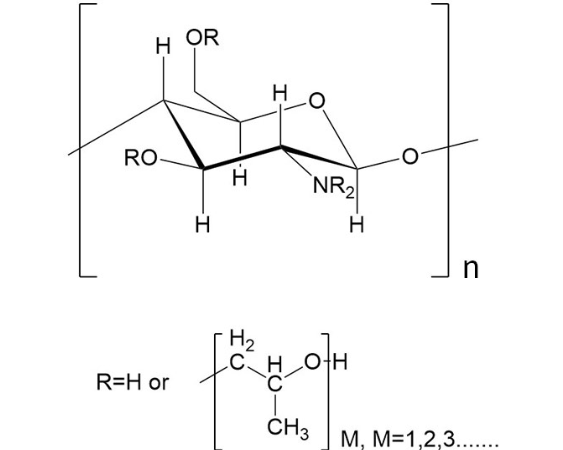
Chemical engineers create Hydroxypropyl Chitosan through a precise etherification process. They introduce bulky hydroxypropyl groups into the primary chitosan backbone. This specific substitution effectively disrupts the tightly packed inter- and intramolecular hydrogen bonds. The native polymer can no longer maintain its rigid, insoluble crystalline structure. The added groups act like physical wedges. They force the polymer chains apart. This allows water molecules to hydrate the polymer chain effortlessly, unlocking broad-spectrum solubility.
This structural change heavily dictates its physical behavior. The resulting polymer exhibits highly desirable characteristics for stable formulations.
It maintains a predominantly non-ionic profile. Depending on the exact degree of substitution, it may act weakly cationic.
It features massive steric hindrance. This physical bulkiness prevents polymer chains from aggregating.
It resists precipitation, even when introduced into highly complex, multi-ingredient chemical mixtures.
It exhibits excellent film-forming capabilities, leaving a breathable, non-tacky layer upon drying.
These unique behavioral traits dictate its ideal commercial use cases. HPCS excels in transdermal delivery systems. It forms strong, flexible matrix patches. We also see it heavily utilized in ocular formulations. Eye drops require neutral pH and absolute clarity. HPCS delivers exactly that. It also serves as a premier stabilizing matrix for the preservation of highly sensitive APIs. Since it lacks a strong ionic charge, it will not aggressively bind to or deactivate fragile drug molecules.
Chemists synthesize carboxymethyl chitosan by introducing hydrophilic carboxymethyl groups into the native polymer structure. This modification occurs at specific reactive sites. It results in three distinct variants. You can produce O-substituted, N-substituted, or N,O-substituted carboxymethyl chitosan. The exact site of substitution radically alters the final polymer's behavior. Controlling this reaction requires advanced synthesis techniques. Formulators must know exactly which variant they are sourcing to ensure predictable results in their final products.
CMCS behaves fundamentally differently than its hydroxypropyl counterpart. It acts as an amphoteric polymer.
It contains both basic amino groups and acidic carboxyl groups along its backbone.
It exhibits a distinct isoelectric point (pI).
It is highly soluble in heavily acidic and heavily alkaline environments.
It can suddenly precipitate near its neutral isoelectric point. This depends heavily on the specific substitution type and molecular weight.
These dynamic, pH-responsive characteristics make it incredibly valuable for specialized applications. CMCS dominates in the creation of advanced hydrogels for wound dressings. The polymer swells massively when it encounters wound exudate. This creates an optimal moist healing environment. It is also heavily used in tissue engineering scaffolds. Its amphoteric nature mimics natural biological extracellular matrices. Furthermore, industrial sectors utilize it for wastewater chelation. The dual-charge profile aggressively binds to heavy metal ions, pulling them out of contaminated solutions effectively.
When executing a thorough solubility comparison, HPCS demonstrates remarkable consistency. It delivers broad-spectrum water solubility independent of strict pH parameters. You can drop it into a pH 5 formulation or a pH 8 formulation. It dissolves predictably. It stays in solution. This makes it highly reliable in neutral cosmetic formulations. Formulators do not have to worry about sudden cloudiness or phase separation.
Conversely, CMCS solubility is highly dependent on both the site of substitution (N- vs. O-) and the pH of the surrounding media. O-substituted CMCS maintains excellent solubility across a broad pH range. However, N-substituted variants often precipitate precisely at physiological pH due to their isoelectric point. You must carefully match the specific substitution type to your target pH environment.
| Polymer Type | Primary Charge | pH Solubility Profile | Precipitation Risk |
|---|---|---|---|
| Native Chitosan | Cationic | Soluble only < pH 6.0 | High at neutral/basic pH |
| Hydroxypropyl Chitosan | Non-ionic / Weak Cationic | Broad spectrum (pH 2 - 12) | Extremely low |
| Carboxymethyl Chitosan | Amphoteric | High in Acid & Base (pH-dependent) | Moderate (at isoelectric point) |
HPCS exhibits moderate antibacterial properties. It does not actively hunt and destroy pathogens aggressively. Instead, it excels primarily in acting as a passive, stabilizing matrix. It functions beautifully as a controlled-release vehicle. It encapsulates active ingredients and slowly degrades, releasing them over time. We rely on HPCS when we want the active ingredient to do the heavy lifting, not the polymer itself.
CMCS offers a drastically different biological profile. It features strong, scientifically documented antibacterial activity. It frequently outperforms native chitosan in bacterial inhibition assays. The carboxyl groups interact aggressively with bacterial cell walls. This disrupts microbial integrity. However, this efficacy is heavily influenced by a high degree of substitution. You need a heavily modified CMCS polymer to maximize this potent antimicrobial effect in wound care or specialized coatings.
Understanding hydroxypropyl chitosan vs carboxymethyl chitosan requires examining chemical compatibility. HPCS benefits immensely from its non-ionic nature. It rarely interacts negatively with common formulation ingredients. You can mix it with anionic surfactants. You can blend it with standard cosmetic thickeners. It will not form clumps. It acts as a friendly, cooperative excipient in complex mixtures.
CMCS requires much tighter formulation control. Its amphoteric nature demands careful charge balancing. If you pair it indiscriminately with incompatible ionic polymers, it will undergo coacervation. The formulation will suddenly clump, turn stringy, or separate entirely. Formulators must constantly monitor the overall ionic strength of the mixture. You must test it rigorously against every surfactant and active compound in the matrix.
Sourcing either derivative demands stringent quality assurance protocols. Synthesis optimization variability is a massive industry risk. Variations in the degree of substitution (DS) between production batches will drastically alter your final product. Molecular weight (Mw) fluctuations will ruin your targeted viscosity. If a supplier ships a batch with a 40% substitution rate instead of 80%, your hydrogel might turn into liquid. Formulators must establish extremely tight raw material specifications.
Commercial scalability also differs between the two materials. Carboxymethylation represents a more established, highly scalable commercial process. This maturity often makes CMCS more cost-effective for large-volume bulk applications, such as agricultural coatings or industrial water treatment. Hydroxypropyl derivation utilizes propylene oxide, which can be slightly more complex to handle and scale. This complexity typically elevates raw material costs, pushing HPCS toward premium pharmaceutical and high-end cosmetic applications.
Regulatory compliance presents an unavoidable reality for both derivatives. Neither polymer gets a free pass into medical devices or pharmaceuticals. You must perform rigorous chemical characterization. You need Nuclear Magnetic Resonance (NMR) spectroscopy and Fourier-Transform Infrared (FTIR) spectroscopy data. These tests prove the exact molecular structure. More importantly, they prove the absolute lack of residual toxic crosslinkers or unreacted chemical reagents. Regulatory bodies demand flawless purity documentation before approving them for human use.
Selecting the correct polymer prevents costly reformulation loops late in the development cycle. Follow this systematic approach for proper biomaterial selection to ensure optimal performance.
Step 1: Define pH constraints. Analyze your final required pH. If the formula must remain strictly neutral and chemically non-reactive, lean heavily toward Hydroxypropyl Chitosan. It offers the safest, most predictable path.
Step 2: Identify primary mechanism. Determine what the polymer needs to do. If rapid swelling, extreme moisture retention, or pH-triggered drug release is your primary goal, shortlist CMCS immediately. It excels at dynamic, responsive behaviors.
Step 3: Test ionic compatibility. Do not trust theoretical data alone. Run rapid bench-top compatibility tests. Mix your chosen polymer with your primary surfactants and APIs. Observe for cloudiness, precipitation, or unexpected viscosity spikes.
Step 4: Audit suppliers aggressively. Never accept generic purity claims. Request specific Certificates of Analysis (CoA). Demand that they detail the precise molecular weight and the exact degree of substitution for the current batch.
Neither chitosan derivative is universally superior. They serve entirely distinct formulation architectures. Hydroxypropyl chitosan wins decisively on long-term chemical stability and broad-spectrum matrix compatibility. It acts as the ultimate reliable, non-reactive scaffold. Carboxymethyl chitosan dominates in highly responsive hydrogels, tissue engineering, and active antibacterial applications where dynamic polymer behavior is required.
Your immediate next step involves physical testing. We highly recommend initiating pilot formulations. Procure small batches of both functional derivatives. Keep your formulation matrix identical, and hold the degree of substitution and molecular weight as strictly controlled variables. This empirical testing will immediately reveal which polymer aligns with your target rheology.
Stop fighting native chitosan insolubility. Request a technical consultation or secure a targeted sample kit today. Test the rheological stability directly in your specific application matrix to accelerate your product development lifecycle.
A: Both are highly water-soluble compared to native chitosan. However, HPCS offers more consistent solubility across a wider, uninterrupted pH range. It remains stable in neutral solutions. CMCS solubility depends heavily on its specific isoelectric point and can precipitate depending on substitution types.
A: CMCS is generally more researched for cardiovascular tissue engineering. Its amphoteric nature closely mimics certain biological tissues. It also possesses a unique ability to form sophisticated, stimuli-responsive hydrogels that support cellular growth and targeted therapy delivery.
A: A higher degree of substitution generally increases water solubility. It also heavily alters biological properties, such as increasing antibacterial efficacy in CMCS. However, modifying the polymer chain too heavily can significantly weaken the structural and mechanical strength of the resulting films or gels.
A: Neither is universally "FDA approved" as a standalone, blanket entity. Regulatory bodies evaluate them strictly as excipients or biomaterials within specific medical device (510k/PMA) or drug (NDA) applications. Approval relies entirely on proven purity, absence of residual reagents, and the specific intended use.


