

close
Choose Your Site
Global
Social Media
Views: 0 Author: Site Editor Publish Time: 2026-09-14 Origin: Site


Transitioning biopolymer formulations from bench-scale research to commercial manufacturing exposes severe vulnerabilities in material selection. Development teams routinely encounter high failure rates during this phase due to unpredictable polymer behavior and unforeseen chemical interactions. Utilizing poorly characterized raw materials introduces significant financial and regulatory risks. These risks manifest as severe batch-to-batch variability, unacceptable endotoxin levels, mechanical degradation during high-shear processing, and unexpected reactions between the active pharmaceutical ingredient (API) and the excipient.
Mitigating these scale-up risks requires abandoning commodity-grade materials. Formulators must standardize their processes around a well-defined Pharmaceutical Excipient Chitosan Series. Implementing a rigorous specification framework ensures reproducible pharmacokinetics, maintains strict regulatory compliance, and enables integration into continuous manufacturing lines. By controlling the biomaterial's structural parameters from the outset, engineering teams can predict rheological behavior, prevent downstream processing bottlenecks, and secure the long-term stability of the final dosage form.
Transitioning to commercial scale requires strict adherence to Critical Quality Attributes (CQAs), specifically Degree of Deacetylation (DDA), Molecular Weight (Mw), and endotoxin limits.
Selecting the correct derivative (e.g., hydroxypropyl, carboxymethyl, or succinyl) dictates not only the drug delivery mechanism but also the complexity of large-scale downstream processing.
The inherent chemical structure of chitosan (abundant amine and hydroxyl groups) offers dual-function benefits like free-radical scavenging, but requires rigorous API-compatibility testing to prevent formulation instability.
Regulatory viability hinges on sourcing from suppliers with established Drug Master Files (DMFs) and rigorous cGMP traceability from raw material extraction to final purification.
Manufacturing integration demands early evaluation of the biomaterial's rheological behavior under commercial drying and milling conditions to prevent flowability and solubility issues.
Commercial manufacturing demands tight control over the biomaterial's structural identity. The Degree of Deacetylation (DDA) directly governs the polymer's charge density, solubility profile, and mucoadhesive strength. Formulators must define acceptable DDA tolerance ranges, typically holding variations to within ±2% for commercial batches. Fluctuations beyond this margin alter the degradation kinetics in vivo and cause unpredictable release profiles in controlled-release matrices. When operating a 500-liter compounding vessel, a minor shift in DDA can completely change the dissolution profile of the final matrix tablet, leading to batch rejection.
Molecular Weight (Mw) requires equally stringent oversight. Mw dictates the zero-shear viscosity of the polymer solution. High Mw variants provide robust structural integrity for hydrogels but severely complicate pumping and filtration during scale-up. Establishing a narrow polydispersity index (PDI) ensures uniform chain lengths, which translates to predictable rheological behavior under mechanical stress. A wide PDI indicates a mixture of short and long polymer chains. The short chains dissolve rapidly and alter the initial burst release of the API, while the long chains increase viscosity and block extrusion nozzles.
Purity requirements scale aggressively depending on the administration route. Pharmaceutical grades must adhere to strict thresholds for heavy metals, residual solvents, and bioburden. Parenteral applications demand aggressive endotoxin removal, often requiring limits below 100 EU/g. Achieving these levels necessitates advanced purification techniques like ultrafiltration and phase separation during raw material processing. Standard filtration will not remove endotoxins; the facility must utilize validated depyrogenation steps.
| Quality Attribute | Oral Solid Dosage Limits | Parenteral Delivery Limits | Primary Analytical Method |
|---|---|---|---|
| Endotoxins | < 500 EU/g | < 100 EU/g (often < 10 EU/g) | LAL Assay / Recombinant Factor C |
| Heavy Metals (Pb, As, Cd, Hg) | USP <232> / ICH Q3D compliant | Strict ICH Q3D parenteral limits | ICP-MS |
| Bioburden (TAMC) | < 1000 CFU/g | Sterile / < 10 CFU/g pre-filtration | Membrane Filtration / Plate Count |
| Molecular Weight (Mw) Tolerance | ± 15% of target | ± 5% to 10% of target | GPC / SEC-MALS |
| Degree of Deacetylation (DDA) | ± 5% variance | ± 2% variance | 1H-NMR / Potentiometric Titration |
The chemical backbone of this biopolymer features highly reactive primary amine groups at the C-2 position and hydroxyl groups at the C-3 and C-6 positions. These functional groups dictate how the excipient interacts with the active pharmaceutical ingredient. Formulators must map these interactions early in the development cycle to prevent late-stage stability failures during accelerated aging studies.
The primary amine acts as a strong nucleophile. This presents a significant risk when formulating with APIs containing aldehyde or ketone functional groups. Under specific moisture and temperature conditions, the amine will attack the carbonyl carbon, leading to Schiff base formation. This covalent bonding permanently traps the API, reducing bioavailability and generating unknown degradants. Manufacturing teams must control the water activity (Aw) of the final dosage form and strictly regulate compounding temperatures to suppress this reaction pathway.
Conversely, these same functional groups offer distinct formulation advantages. The hydroxyl and amine groups exhibit potent free-radical scavenging capabilities. This inherent antioxidant property can stabilize oxidation-sensitive APIs, extending the shelf life of the final product. Leveraging this dual nature requires comprehensive excipient compatibility screening. Engineering teams should utilize techniques like Differential Scanning Calorimetry (DSC) and Fourier Transform Infrared Spectroscopy (FTIR) on stressed binary mixtures to identify interaction risks before moving to pilot-scale production.
Conduct initial binary mixture screening at 40°C/75% RH for 4 weeks.
Analyze samples using HPLC to detect API degradation peaks.
Perform FTIR analysis to identify new covalent bonds, specifically looking for imine stretch bands indicative of Schiff base formation.
Adjust formulation pH or utilize steric hindrance strategies if reactivity is detected.
Raw material sourcing fundamentally impacts polymer uniformity. Traditional extraction relies on crustacean shells sourced from the seafood industry. This supply chain introduces inherent seasonal variations in calcium carbonate, lipid, and protein content. Manufacturers must implement aggressive demineralization and deproteinization protocols to normalize these variations before deacetylation. Failure to standardize the incoming raw material results in fluctuating ash content and inconsistent polymer chain lengths.
Alternative sourcing strategies are gaining traction to mitigate these inconsistencies. Controlled fungal fermentation (e.g., Aspergillus niger) and emerging insect-derived sources provide a highly standardized starting material. These non-animal sources eliminate seasonal variability, reduce the risk of heavy metal bioaccumulation, and bypass shellfish allergenicity concerns. Fermentation allows for precise control over the growth medium, yielding a highly reproducible chitin precursor.
Regardless of the source, standardizing the polydispersity index across commercial-volume batches remains non-negotiable. Wide molecular weight distributions lead to inconsistent drug release rates and variable mechanical properties in solid dosages. Suppliers must utilize validated, controlled degradation processes to narrow the PDI. This ensures every commercial batch performs identically to the pivotal clinical trial material. Process engineers should demand historical PDI trend data from suppliers during the initial qualification phase.
Native biopolymers often struggle with aqueous solubility at physiological pH. Modifying the polymer backbone to create hydroxypropyl chitosan resolves this limitation. The introduction of bulky hydroxypropyl groups disrupts the highly ordered crystalline structure and internal hydrogen bonding. This modification grants the excipient excellent water solubility across a broad pH range, eliminating the need for acidic dissolution vehicles.
This enhanced solubility profile makes it an ideal candidate for non-invasive, targeted delivery systems. Formulators heavily utilize it in ocular drops, where neutral pH solubility is mandatory to prevent eye irritation and corneal damage. It also excels in mucosal delivery platforms, providing strong tissue adhesion without requiring acidic buffers that could damage sensitive epithelial layers. The polymer chains interpenetrate the mucin network, extending the residence time of the API at the absorption site.
Scaling up this derivative introduces specific manufacturing trade-offs. The etherification process requires precise control over reaction kinetics, temperature, and reagent stoichiometry. Achieving a consistent degree of substitution (DS) at commercial reactor volumes increases production costs. Propylene oxide, the common etherifying agent, requires specialized handling and explosion-proof reactor environments. Engineering teams must balance the functional benefits of neutral solubility against the increased complexity of downstream purification and solvent recovery.
Introducing carboxymethyl groups onto the polymer chain yields an amphoteric derivative with unique pH-responsive characteristics. carboxymethyl chitosan contains both basic amine groups and acidic carboxyl groups. This dual-charge nature allows the material to swell, gel, or dissolve depending on the surrounding environmental pH and ionic strength.
Formulators leverage this property to design smart, controlled-release matrices. In the acidic environment of the stomach, the polymer remains protonated and compact, protecting acid-labile APIs from degradation. As the dosage form transitions into the neutral pH of the intestinal tract, the carboxyl groups ionize. The resulting electrostatic repulsion causes the matrix to swell rapidly, releasing the payload exactly at the site of optimal absorption. This targeted release mechanism improves the bioavailability of peptide and protein drugs.
Implementing this material at scale requires strict management of viscosity stability. The amphoteric nature makes the polymer highly sensitive to local pH fluctuations during compounding. High-shear mixing can induce premature gelation if the buffer system is not tightly controlled. Process engineers must design compounding sequences that maintain the polymer in a stable state until the final drying or extrusion phase. Adding the polymer to the solvent too quickly will result in "fish-eyes"—agglomerated particles with a dry core that refuse to hydrate.
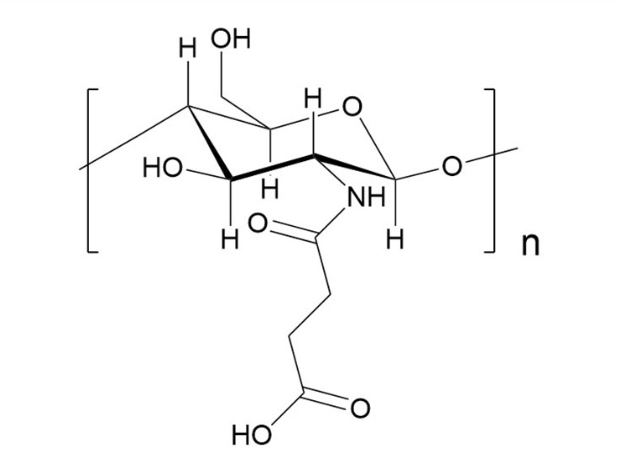
Advanced therapeutic applications often require excipients that can evade rapid immune clearance. succinyl chitosan achieves this through the introduction of succinyl groups, which impart a net negative charge at physiological pH. This structural modification reduces protein adsorption and macrophage uptake, significantly extending the systemic circulation time of nanoparticle delivery systems. The negative charge repels serum proteins that would otherwise opsonize the particle for destruction by the reticuloendothelial system.
Beyond systemic delivery, this derivative provides exceptional structural integrity for tissue engineering scaffolds. The pendant carboxyl groups offer accessible sites for chemical cross-linking using agents like EDC/NHS or genipin. This allows researchers to tune the mechanical stiffness and degradation rate of the scaffold to match the target tissue, supporting cellular proliferation and extracellular matrix deposition.
Transitioning these cross-linked systems from lab-scale batches to commercial reactor volumes requires highly predictable reaction kinetics. Heat transfer and mixing efficiency change drastically as reactor size increases from 5 liters to 500 liters. Process chemists must carefully map the cross-linking behavior, adjusting initiator concentrations and curing times. If the impeller shear rate is too low, localized areas of high cross-link density will form, resulting in a heterogeneous scaffold that fails compressive strength testing.
Integrating pharmaceutical chitosan derivatives into continuous manufacturing lines requires a deep understanding of their rheological behavior. These polymer solutions exhibit non-Newtonian, shear-thinning (pseudoplastic) flow. While apparent viscosity drops under the high shear of an extruder or homogenizer, it recovers rapidly once the stress is removed. Failure to account for this recovery leads to clogged nozzles, blocked transfer lines, and inconsistent coating thicknesses on tablet beds.
Commercial drying methods drastically alter the final powder's physical properties. Lyophilization (freeze-drying) produces a highly porous, low-density sponge. This material dissolves rapidly but exhibits terrible flowability, making it unsuitable for high-speed tablet presses. The powder will bridge in the hopper and cause severe weight variations in the final tablets. Spray drying generates spherical particles with higher bulk density. Engineers must optimize inlet temperatures (typically between 160°C and 190°C) and atomization pressures to achieve a Carr's Compressibility Index that supports direct compression.
Handling lipid-based nanoparticle systems introduces additional constraints. The polymer's inherent lipid-binding properties can cause phase separation or unwanted agglomeration during high-pressure homogenization. Formulators must carefully sequence the addition of the polymer phase to the lipid phase. This often requires precise temperature control via jacketed vessels to maintain the lipid in a molten state while preventing thermal degradation of the biopolymer.
| Drying Method | Particle Morphology | Flowability (Carr's Index) | Primary Manufacturing Application |
|---|---|---|---|
| Lyophilization | Porous, irregular flakes | Poor (> 25) | Injectable hydrogels, wound dressings |
| Spray Drying | Spherical, dense | Excellent (< 15) | Direct compression solid oral dosages |
| Supercritical Fluid Drying | Highly uniform microparticles | Good (15 - 20) | Inhalable dry powder formulations |
Commercial production timelines cannot accommodate slow, lab-scale analytical techniques. Quality control units must validate high-throughput methods to release batches efficiently. Proton Nuclear Magnetic Resonance (1H-NMR) remains the gold standard for determining DDA, but sample preparation requires specific deuterated solvents and extended dissolution times. Facilities must streamline these protocols, potentially utilizing automated sample changers and optimized pulse sequences to support rapid turnaround.
Monitoring molecular weight requires Gel Permeation Chromatography (GPC) coupled with Multi-Angle Light Scattering (MALS). This setup provides absolute molecular weight data without relying on arbitrary calibration standards. Selecting the correct column chemistry and mobile phase ionic strength is critical. If the mobile phase does not adequately shield the polymer's charges, the material will interact with the stationary phase, skewing the PDI results and delaying batch release.
Continuous manufacturing relies heavily on Process Analytical Technology (PAT). In-line Near-Infrared (NIR) spectroscopy is essential for monitoring moisture content during fluid bed drying or extrusion. Real-time thermal sensors must track the material temperature to prevent localized overheating. Exceeding the polymer's thermal degradation threshold causes chain scission, dropping the molecular weight and destroying the batch's rheological profile.
Global commercialization requires navigating fragmented regulatory standards. The United States Pharmacopeia (USP), European Pharmacopoeia (EP), and Japanese Pharmacopoeia (JP) each maintain specific monographs for this biomaterial. Significant harmonization gaps exist between these agencies. The USP dictates specific rotational viscometer parameters and spindle types, while the EP enforces distinct heavy metal limits and ash content thresholds.
Formulators cannot assume a material compliant in one region automatically satisfies another. Regulatory teams must perform a rigorous gap analysis of the supplier's Certificate of Analysis (CoA) against all target market monographs. Missing a single regional specification can trigger a complete clinical hold or market rejection. The analytical methods used by the supplier must be cross-validated against the specific compendial methods required by the target regulatory body.
Accelerating regulatory submissions depends entirely on the supplier's documentation infrastructure. Sourcing materials backed by an active Type IV Drug Master File (DMF) is mandatory. A comprehensive DMF allows the regulatory agency to review the proprietary manufacturing, extraction, and purification processes without the supplier disclosing trade secrets to the drug manufacturer. This pre-validated data drastically reduces the review timeline for the final New Drug Application (NDA).
Auditing biopolymer suppliers requires looking far beyond the final purification facility. The evaluation framework must encompass the entire supply chain, starting at the raw material extraction site. Auditors must verify cGMP compliance at the facilities handling the initial demineralization and deproteinization. Poor environmental controls at these early stages introduce bioburden and heavy metal contamination that downstream purification cannot reliably remove.
Supply chain resilience is a critical risk factor. Geographic concentration of raw material sourcing exposes the manufacturer to weather events, trade disputes, and seasonal shortages. Suppliers must demonstrate robust raw material traceability, documenting the exact origin, harvest date, and species of the source material. This traceability is vital for investigating out-of-specification (OOS) results during commercial production.
The audit must assess the supplier's proven capacity to scale. A supplier may produce flawless 10-kilogram pilot batches but fail completely when transitioning to 1,000-kilogram commercial reactors. Engineering teams must review the supplier's heat transfer capabilities, solvent recovery efficiency, and quality control throughput to ensure they can meet projected commercial volumes without compromising the established CQAs.
Execute the following steps to advance your scale-up planning:
Request detailed technical data sheets and batch-to-batch PDI variance reports from shortlisted suppliers to verify historical consistency.
Initiate accelerated material compatibility testing using stressed binary mixtures to identify potential Schiff base formation risks with your target API.
Schedule quality audits of the supplier's extraction and purification facilities to confirm cGMP compliance and raw material traceability.
Conduct rheological profiling of the polymer solutions under the specific high-shear conditions of your commercial manufacturing equipment.
A: Pharmaceutical-grade materials adhere to strict pharmacopeial limits on endotoxins, heavy metals, and bioburden. They require extremely tight tolerances for Degree of Deacetylation (DDA) and Molecular Weight (Mw) to ensure reproducible drug delivery. Food-grade variants lack this rigorous purification and structural control, making them suitable only for dietary supplement applications.
A: Molecular weight directly dictates the zero-shear viscosity of the polymer solution. High Mw variants create highly viscous solutions that severely complicate high-shear mixing, pumping, filtration, and spray-drying processes at commercial volumes. Controlling the Mw and maintaining a narrow polydispersity index is mandatory for predictable manufacturing.
A: These reactive functional groups offer dual properties. They provide beneficial free-radical scavenging abilities, acting as antioxidants to stabilize sensitive formulations. However, the primary amine groups can also react with aldehyde or ketone-containing APIs to form Schiff bases, permanently trapping the drug and requiring strict compatibility testing.
A: Hydroxypropyl chitosan and carboxymethyl chitosan are specifically chemically modified to overcome the poor solubility of the native polymer. These derivatives disrupt internal hydrogen bonding, allowing them to remain highly soluble in aqueous solutions at neutral and basic physiological pH levels.
A: Endotoxin limits are dictated by the route of administration. Oral solid dosages can tolerate higher limits, often up to 500 EU/g. Parenteral grades require extremely stringent purification, typically mandating endotoxin levels below 100 EU/g, and often below 10 EU/g, to prevent severe immune reactions.
A: Consistency requires controlling the entire supply chain. This includes standardizing raw material sourcing to minimize seasonal variations, utilizing validated and tightly controlled deacetylation processes, and performing rigorous analytical testing to ensure a uniform polydispersity index across all commercial batches.
A: Yes. Fungal-derived and emerging insect-derived sources offer highly consistent, non-animal alternatives. These sources eliminate seasonal crustacean variations, significantly reduce the risks of heavy metal bioaccumulation, and completely bypass concerns regarding shellfish allergenicity in the final patient population.


