

close
Choose Your Site
Global
Social Media
Views: 0 Author: Site Editor Publish Time: 2026-07-16 Origin: Site


The shift toward complex active pharmaceutical ingredients, including biologics, oligonucleotides, and poorly soluble small molecules, has exposed the limitations of traditional excipients in achieving targeted, controlled, or sustained drug release. Standard inactive ingredients often fail to provide the necessary physiological interaction required for advanced delivery mechanisms, leading to suboptimal bioavailability and compromised therapeutic outcomes.
Formulation scientists and R&D directors face a complex technical bottleneck. They must identify biocompatible, functional biopolymers that offer precise tunability for advanced drug delivery systems. At the same time, they need to maintain strict compliance with global pharmacopeial standards and ensure commercial-scale batch-to-batch reproducibility. The challenge lies in sourcing materials that bridge the gap between innovative molecular design and predictable, scalable manufacturing processes.
This guide provides an in-depth technical evaluation of how utilizing a standardized, highly documented Pharmaceutical Excipient Chitosan Series—incorporating highly purified pharmaceutical chitosan derivatives—bridges the gap between complex molecular delivery requirements and predictable commercial manufacturing.
Derivative Specificity: Selecting the correct functionalized derivative (e.g., hydroxypropyl chitosan, carboxymethyl chitosan, or succinyl chitosan) is mandatory to overcome the narrow, pH-dependent solubility limits of unmodified native chitosan.
Source Material & Traceability: Formulation safety and regulatory approval times are heavily influenced by the origin of the raw material (fungal-derived vs. marine-derived crustacean chitosan), which dictates allergenicity profiles and batch-to-batch structural variance.
Critical Quality Attributes (CQAs): Target release kinetics and safety profiles depend strictly on rigorous vendor characterization of Molecular Weight (Mw) distribution, Degree of Deacetylation (DDA), and ultra-low endotoxin limits.
Regulatory Readiness: Successful clinical translation requires selecting excipient grades backed by robust Type IV Drug Master Files (DMFs), EXCiPACT GMP certifications, and alignment with USP-NF/EP monographs.
Process Compatibility: Early-stage evaluation of rheological properties, hygroscopicity, and sterilization-induced polymer degradation mitigates the risk of catastrophic failures during pilot-scale up.
Modern drug delivery systems demand functional polymers that move beyond simple bulking agents. The baseline requirements for success include high mucoadhesion to prolong residence time at the absorption site, controlled biodegradable kinetics to dictate drug release rates, physiological non-toxicity to ensure patient safety, and active permeation enhancement via tight junction modulation to facilitate the transport of large or hydrophilic molecules across epithelial barriers. Formulators need materials that actively participate in the delivery mechanism rather than just occupying space in the dosage form.
Unmodified native chitosan presents a fundamental chemical challenge. Its solubility is restricted to acidic aqueous environments (pH < 6.0) due to the protonation of its primary amine groups. This characteristic renders native chitosan largely ineffective for systemic physiological delivery, where the pH is typically 7.4, or for intestinal absorption, where the environment is neutral to alkaline. You cannot simply drop native chitosan into a neutral buffer and expect it to perform; it will precipitate out, ruining the formulation.
The source material strategy significantly impacts the final excipient profile. Crustacean-derived chitosan is highly abundant but presents challenges with seasonal molecular weight variation, heavy metal accumulation, and potential shellfish allergenicity due to tropomyosin residues. Conversely, fungal-derived chitosan (e.g., from Aspergillus niger) offers superior batch-to-batch structural uniformity, low heavy metal profiles, zero risk of shellfish allergen contamination, and full compatibility with vegan, kosher, and halal regulatory requirements. We see a strong industry shift toward fungal sources to bypass the extensive purification steps required for marine sources.
| Attribute | Crustacean-Derived | Fungal-Derived (A. niger) |
|---|---|---|
| Batch Uniformity | High seasonal variability | Highly consistent |
| Allergen Risk | Potential shellfish allergens | Zero shellfish allergens |
| Heavy Metal Profile | Prone to bioaccumulation | Strictly controlled, very low |
| Regulatory Compatibility | Standard | Vegan, Kosher, Halal compliant |
To overcome the limitations of native chitosan, a comprehensive Pharmaceutical Excipient Chitosan Series is utilized. Chemical modification of the polymer's primary hydroxyl (-OH) and amine (-NH2) groups yields tailored solubility profiles, customized charge densities, and specific mechanical properties without compromising biopolymer safety. This approach provides formulators with a versatile toolkit of functionalized polymers designed for specific delivery challenges, allowing for precise engineering of the drug release profile.
The etherification of hydroxyl groups with hydroxypropyl groups disrupts the crystalline polymer packing and intra-molecular hydrogen bonding of native chitosan. This modification yields hydroxypropyl chitosan, which exhibits neutral pH solubility and high water retention capacity. These properties are critical for formulations requiring stability and functionality at physiological pH without the need for acidic solubilizers. You gain a polymer that hydrates rapidly and forms clear, viscous solutions at pH 7.4.
For ophthalmic applications, this derivative offers superior film-forming capability, high optical clarity (light transmittance), and non-blurring mucoadhesive interaction with corneal mucin. These characteristics make it the premier candidate for dry-eye formulations and sustained ocular drug delivery, where prolonged contact time and patient comfort are paramount. The polymer matrix holds water against the corneal surface, reducing the frequency of drop administration.
In topical and transdermal systems, it plays a vital role in creating breathable, elastic hydrogel matrices. These matrices enhance the skin penetration of hydrophilic compounds while maintaining local hydration, providing an optimal environment for sustained transdermal drug flux and improved therapeutic efficacy. We use it extensively in wound healing patches where moisture management is a primary requirement.
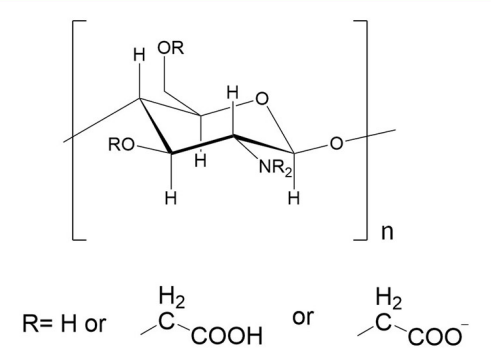
The addition of carboxymethyl groups introduces an amphoteric nature to the polymer, active at both amine and hydroxyl sites. This modification results in carboxymethyl chitosan, which possesses dual-isoelectric point characteristics. Consequently, it achieves solubility across the entire physiological pH range, including acidic, neutral, and alkaline environments, overcoming the primary limitation of native chitosan. This flexibility allows you to formulate liquid oral solutions that remain stable across the entire gastrointestinal tract.
This derivative is particularly suited for enteric and oral controlled-release applications. It exhibits pH-responsive swelling behavior, remaining stable and collapsed in gastric acidity, while swelling and releasing its payload in intestinal neutral or alkaline environments. This behavior effectively shields sensitive APIs, such as peptides or proteins, from proteolytic degradation in the stomach. The polymer acts as a physical barrier until it reaches the target absorption site.
For nasal and buccal mucoadhesion, the specific charge densities of this derivative correlate with the transient opening of epithelial tight junctions. This paracellular transport enhancement maximizes localized mucosal absorption, improving the bioavailability of drugs administered via these routes. It temporarily disrupts the tight junctions, allowing larger molecules to pass through the mucosal barrier before the junctions reseal.
Succinylation introduces succinyl groups into the primary amino groups of chitosan, replacing positive charges with negative carboxylate groups. This chemical mechanism creates an anionic or amphiphilic polymer profile, resulting in succinyl chitosan, which is highly advantageous for specific nanomedicine applications. By flipping the charge profile, you open up entirely new complexation strategies for formulation development.
In nanoparticle engineering, this derivative demonstrates excellent performance in self-assembling micellar structures, polyelectrolyte complexes (PECs), and stable ionic cross-linked nanoparticles. The negative charge density enables the stable encapsulation of highly cationic therapeutic biomolecules, facilitating efficient drug loading and controlled release. We rely on this for delivering positively charged peptides that would otherwise repel native chitosan.
For systemic circulation and biodistribution, the negative surface charge reduces non-specific protein adsorption (opsonization). This property prolongs the half-life of intravenous nanocarriers and prevents rapid clearance by the reticuloendothelial system (RES), enhancing the targeted delivery of therapeutics to specific tissues or organs. It essentially provides a stealth coating for the nanoparticles, allowing them to circulate longer and reach their intended targets.
Molecular weight directly dictates solution viscosity, shear-thinning behavior, gelation temperature, and the mechanical erosion rate of solid dosage matrices. Selecting the appropriate Mw is critical for achieving the desired release profile and processing characteristics during manufacturing. A high Mw grade will create a stiff, slow-eroding matrix, while a low Mw grade will dissolve rapidly, dumping the API.
The Degree of Deacetylation (DDA) percentage, typically ranging from 75% to greater than 95%, correlates with the net positive charge density. This charge density directly impacts cell membrane interaction, mucoadhesive bond strength, and biological biodegradation rates via lysozyme susceptibility. Higher DDA generally results in stronger mucoadhesion and slower degradation. You must match the DDA to the required residence time of your dosage form.
Verifiable quality control requires precise analytical methodologies. We implement strict testing protocols to ensure batch consistency.
High-Performance Size Exclusion Chromatography coupled with Multi-Angle Light Scattering (HPSEC-MALS) is essential to assess the polydispersity index (PDI) and Mw distribution.
Proton Nuclear Magnetic Resonance Spectroscopy is the gold-standard method for DDA determination.
Fourier-Transform Infrared Spectroscopy (FTIR) and potentiometric titration are used as supplementary methods for structural confirmation.
Establishing clear thresholds between Oral/Topical grade requirements and Parenteral/Implantable grade requirements is essential for regulatory compliance and patient safety. Parenteral grades demand significantly higher purity and stricter bioburden controls. You cannot use an oral grade material in an injectable formulation without risking severe patient reactions.
Stringent endotoxin limits are necessary, particularly for injectable formulations, where limits of <0.1 EU/mg or <0.05 EU/mg are standard. Validated testing via Limulus Amebocyte Lysate (LAL) chromogenic assays is required to ensure these critical specifications are met. We reject any batch that approaches the upper control limit for endotoxins.
Testing standards for elemental impurities and heavy metals must map to ICH Q3D guidelines. Inductively Coupled Plasma Mass Spectrometry (ICP-MS) is utilized to accurately quantify arsenic, lead, cadmium, and mercury thresholds in the excipient, ensuring compliance with global safety standards. This is particularly critical when evaluating marine-derived sources.
Understanding the thermodynamic behavior of mixing cationic or anionic derivatives with APIs of opposite charges is crucial. Formulators must leverage electrostatic complexation for stable drug loading while preventing premature API precipitation or denaturation during processing and storage. If you mix a strongly anionic API with a high DDA cationic polymer without proper buffering, you will get immediate precipitation.
Necessary pre-formulation analytical screening techniques include Differential Scanning Calorimetry (DSC) and X-ray Powder Diffraction (XRPD) to assess solid-state interactions, crystallinity changes, and potential incompatibilities between the excipient and the active pharmaceutical ingredient. We run these screens early in development to weed out incompatible polymer-API combinations before investing in scale-up trials.
Evaluate the specific pH and solubility requirements of your target delivery route to select the appropriate functionalized derivative.
Request comprehensive documentation from vendors, including Mw distribution, DDA, and endotoxin levels, to ensure batch-to-batch reproducibility.
Conduct early-stage compatibility screening between the selected derivative and the API to mitigate stability risks during scale-up.
Verify the source material origin and its alignment with your target market's regulatory and dietary requirements.
A: Modified derivatives overcome the limited solubility of native chitosan, which is only soluble in acidic conditions. Derivatives offer solubility across broader physiological pH ranges, enabling diverse delivery applications.
A: Fungal-derived chitosan offers better structural uniformity and eliminates shellfish allergen risks compared to crustacean-derived sources, simplifying regulatory compliance for sensitive patient populations.
A: Hydroxypropyl chitosan is highly suitable due to its neutral pH solubility, excellent film-forming properties, and high optical clarity, providing sustained delivery without blurring vision.
A: It exhibits pH-responsive swelling, remaining collapsed in the acidic stomach to protect the API, and swelling to release the drug in the neutral or alkaline environment of the intestines.
A: DDA determines the polymer's charge density, which directly affects its mucoadhesive strength, interaction with cell membranes, and its rate of biodegradation in the body.
A: Its anionic profile allows for stable encapsulation of cationic biomolecules and reduces non-specific protein adsorption in systemic circulation, prolonging the nanoparticle's half-life.


