

close
Choose Your Site
Global
Social Media
Views: 0 Author: Site Editor Publish Time: 2026-07-17 Origin: Site


In advanced pharmaceutical formulation, the functional performance of modified biopolymers is strictly dictated by their molecular architecture. Precise chemical characterization serves as a non-negotiable baseline for R&D and procurement. Formulators frequently encounter batch-to-batch inconsistencies, unpredictable solubility, and API complexation failures when sourcing modified excipients. These issues typically stem from an improperly specified or poorly controlled Degree of Substitution (DS) in the polymer matrix.
To mitigate formulation risks and ensure regulatory compliance, technical teams must understand exactly how the DS of carboxymethyl chitosan alters its physicochemical behavior, biological efficacy, and overall viability compared to other options in the excipient portfolio. Mastering these variables allows for the development of stable, effective, and reproducible drug delivery systems.
Solubility and Stability Correlation: A higher DS (typically between 0.7 and 1.2) directly correlates with enhanced aqueous solubility, improved solution transparency, and superior solution stability across varying pH levels.
Complexation Dynamics: The specific DS and polymer-to-polymer ratios dictate the availability of carboxymethyl groups, fundamentally altering how the excipient complexes with active pharmaceutical ingredients (APIs) and other polymers.
Biological Efficacy: Variations in substitution levels—specifically exceeding a 50% (0.5) DS threshold—significantly impact the antibacterial, antioxidant, and biocompatibility profiles of the final formulation.
Procurement and QA Imperative: Validating DS through standardized analytical methods (such as FTIR spectroscopy, NMR, and solubility tests) is critical for ensuring batch reproducibility and mitigating downstream manufacturing risks.
Establishing the baseline requirements for water-soluble biopolymers in drug delivery systems requires addressing the inherent limitations of native, unmodified chitosan. While native chitosan offers excellent biocompatibility, its poor solubility at neutral and alkaline pH severely restricts its application in physiological environments. To overcome this, chemical modification introduces specific functional groups that disrupt the strong intermolecular hydrogen bonding of the polymer backbone.
Within the broader Pharmaceutical Excipient Chitosan Series, different derivatives serve distinct formulation needs. Carboxymethylation stands out for its amphoteric and anionic properties, enabling pH-sensitive swelling ideal for targeted drug delivery and wound healing matrices. We can contrast this with hydroxypropyl chitosan, a non-ionic derivative known for its organic solvent solubility and excellent film-forming capabilities, which is highly valued in transdermal patches and topical coatings. Alternatively, succinyl chitosan provides a highly anionic profile, offering superior moisture retention and long-circulating properties suitable for systemic delivery.
Evaluating these fundamental chemical modifications reveals how the introduction of functional groups overcomes inherent solubility barriers without sacrificing the base polymer's biocompatibility. The choice of derivative hinges on matching the specific chemical functionality to the target release profile and administration route.
| Derivative Type | Ionic Character | Primary Functional Benefit | Common Pharmaceutical Application |
|---|---|---|---|
| Carboxymethyl | Amphoteric / Anionic | Broad pH solubility, mucoadhesion | Targeted delivery, wound hydrogels |
| Hydroxypropyl | Non-ionic | Organic solvent solubility, film-forming | Transdermal patches, coatings |
| Succinyl | Highly Anionic | Moisture retention, long circulation | Systemic delivery, nanoparticles |
When formulating with pharmaceutical chitosan derivatives, you must evaluate the specific substitution patterns. The functional groups dictate how the polymer interacts with water molecules, active pharmaceutical ingredients, and cellular membranes. A thorough understanding of these interactions prevents costly failures during scale-up and clinical trials.
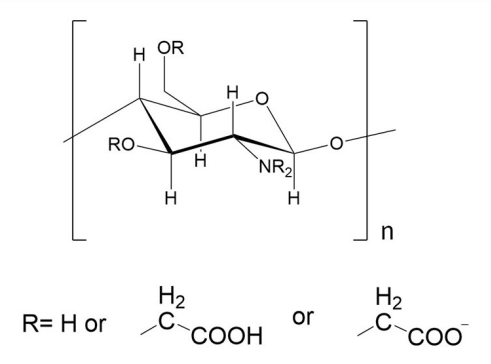
The Degree of Substitution (DS) is defined as the average number of substituted hydroxyl or amino groups per saccharide unit in the polymer chain. It represents the chemical density of the modification. Since each monomeric unit of chitosan has a maximum of three reactive sites (one amino group at C-2 and two hydroxyl groups at C-3 and C-6), the theoretical maximum DS is 3.0. In practical pharmaceutical applications, the DS typically ranges from 0.5 to 1.5.
Understanding the site of substitution is just as critical as the overall density. O-carboxymethylation occurs when the substitution targets the hydroxyl groups, preserving the primary amine and maintaining a strong polycationic character at low pH. N-carboxymethylation involves substitution at the amino group, shifting the polymer toward a more anionic profile. O,N-carboxymethylation features substitutions at both sites, creating a highly amphoteric molecule. The specific substitution pattern dictates the polymer's isoelectric point and its behavior in varying pH environments.
Industry-standard methods for quantifying DS are essential for validating raw materials before they enter the manufacturing floor. Relying solely on supplier documentation without internal verification often leads to formulation inconsistencies.
FTIR Spectroscopy: This provides a chemical fingerprint, identifying the presence of carboxylate bands. Technicians look for specific absorption peaks to confirm the presence of the functional groups.
NMR (1H and 13C): Nuclear Magnetic Resonance offers precise structural determination. It allows chemists to calculate the exact ratio of substituted groups to the polymer backbone, providing the most accurate DS measurement.
Potentiometric Titration: This wet chemical method measures the buffering capacity of the functional groups. It is a practical, cost-effective way to verify the ionic character of the batch.
Standardized Solubility Tests: Cross-verifying chemical findings with functional physical behavior ensures the polymer performs as expected in aqueous media. If a high-DS batch fails to dissolve completely, it indicates heterogeneous substitution.
The relationship between DS values and solubility is the most immediate functional impact of chemical modification. A DS threshold between 0.7 and 1.2 marks the transition from acid-dependent solubility to broad-spectrum aqueous solubility. At this level, the introduction of bulky carboxymethyl groups sufficiently disrupts the crystalline structure of the native polymer, allowing water molecules to hydrate the chain effectively across a wide pH range.
Solution transparency serves as a direct indicator of homogeneous substitution distribution. High-quality derivatives with uniform substitution yield clear solutions, whereas heterogeneous substitution often results in turbidity and micro-gel formation. Improved solubility and solution transparency reduce the need for acid stabilizers or co-solvents, significantly simplifying the manufacturing process for liquid, ophthalmic, and injectable formulations.
Higher substitution levels fundamentally alter the hydrodynamic volume of the polymer. The anionic charges introduced by carboxymethylation create intermolecular repulsion, causing the polymer coils to expand in solution. This expansion enhances the polymer's performance as a viscosity modifier and thickening agent, providing a smooth, stable rheological profile suitable for gels and suspensions.
Thermodynamic stability is also heavily influenced by DS. Formulations utilizing high-DS variants demonstrate superior stability under thermal stress, including autoclaving processes required for sterile preparations. They maintain their structural integrity and viscosity under varying shear rates during industrial scale-up, preventing phase separation or premature degradation.
A higher DS provides more available carboxyl groups for electrostatic complexation. This is particularly relevant when formulating polyelectrolyte complexes (PECs) with residual positive amino groups of native chitosan or cationic APIs. The density of these negative charges dictates the strength and efficiency of the complexation process.
Evaluating the stoichiometric ratio between high-DS polymers and other components is critical. This ratio dictates the zeta potential, particle size, and encapsulation efficiency of nanoparticles. In hydrogel applications, the DS and polymer ratios govern the mechanical strength, pore size, and degradation rates of the matrix, directly influencing the release kinetics of the encapsulated drug.
| DS Range | Solubility Profile | Complexation Strength | Ideal Formulation Type |
|---|---|---|---|
| 0.3 - 0.5 | Acid-dependent | Weak to Moderate | Solid dosage forms, basic films |
| 0.6 - 0.8 | Moderate aqueous | Strong | Topical gels, wound dressings |
| 0.9 - 1.2 | High aqueous (broad pH) | Very Strong | Injectables, ophthalmic drops |
Empirical evidence demonstrates that a Degree of Substitution exceeding 50% (0.5 DS) serves as a critical threshold for activating robust antibacterial and antioxidant activities. Below this threshold, the polymer lacks sufficient functional density to interact effectively with biological membranes or reactive oxygen species.
The mechanism of action relies on the density of functional groups. A high DS enhances the polymer's ability to disrupt bacterial cell membranes via electrostatic interactions. Furthermore, the increased electron and hydrogen donating capacity allows the polymer to scavenge free radicals efficiently. These properties translate into tangible benefits for topical formulations, active wound dressings, and preservative-free pharmaceutical preparations, where inherent antimicrobial action extends shelf life and improves patient outcomes.
High-substitution synthesis must be carefully controlled to ensure safety. When properly purified of residual reagents such as monochloroacetic acid, highly substituted derivatives maintain the inherent non-toxicity and biodegradability of the base polymer. Rigorous purification protocols are mandatory to prevent cellular toxicity in sensitive applications like injectables or ophthalmic drops.
The release kinetics of a formulation are governed by the swelling index, water uptake, and enzymatic degradation rate of the polymer matrix. Because a higher DS increases hydrophilicity and swelling capacity, formulators can precisely tune the sustained release of therapeutics by selecting a specific substitution grade, ensuring the API reaches the target site at the optimal therapeutic concentration.
The synthesis of modified biopolymers is highly sensitive to raw material characteristics. The particle size of the precursor chitosan powder dictates the surface area available for the etherification reaction. Smaller precursor particle sizes provide a larger reactive surface area, facilitating deeper and more uniform penetration of the alkalizing agents and reactants.
Optimizing this process establishes a direct relationship between smaller particle sizes, higher reaction efficiency, and the achievement of a uniformly high, homogeneous DS. Conversely, poor control over synthesis parameters introduces severe implementation risks. Heterogeneous substitution, where localized high and low DS regions exist within the same batch, leads to unpredictable swelling, micro-gel formation, and downstream batch-to-batch solubility failures.
Milling and Sieving: Ensure precursor powder meets strict particle size distribution specifications before synthesis.
Alkalization Control: Monitor temperature and time precisely to ensure uniform activation of the polymer chains.
Etherification Monitoring: Control the ratio of monochloroacetic acid to polymer to target the desired DS accurately.
Purification: Implement rigorous washing steps to remove unreacted reagents and byproducts, ensuring pharmaceutical-grade purity.
Selecting the appropriate specification requires aligning the chemical properties with the administration route. You must evaluate the physical demands of the final product against the chemical capabilities of the excipient.
Topical and Transdermal: Prioritize film-forming ability, moisture retention, and antimicrobial properties. A moderate to high DS is optimal for these applications.
Oral and Enteric: Focus on pH-responsive swelling, enteric protection, and mucoadhesion. This requires specific O/N substitution ratios and a moderate DS to ensure stability in gastric acid and targeted release in the intestinal tract.
Injectable Hydrogels and Nanoparticles: Demand ultra-pure, highly soluble grades with precise complexation capabilities. A strictly controlled high DS of 0.8–1.2, paired with validated low endotoxin levels, is mandatory.
Formulators must balance competing physical requirements. Rapid dissolution is highly desirable for liquid formulations, but it must be weighed against the requirement for mechanical strength and slower degradation in solid dosage forms or cross-linked hydrogels. A very high DS maximizes solubility but may reduce the structural integrity of a sustained-release matrix.
Additionally, R&D teams must evaluate cost versus performance. Highly purified, custom-DS derivatives carry a premium cost. However, this initial investment is often offset by the formulation efficiencies, stability gains, and biological benefits they unlock, reducing overall manufacturing complexity and failure rates.
Establishing strict criteria for supplier qualification is a regulatory necessity. Procurement teams must demand comprehensive Certificates of Analysis (CoA) that provide transparent reporting of DS, O/N substitution ratio, molecular weight, residual reactants, and endotoxin levels.
Implementing incoming quality control (IQC) protocols mitigates risk. Utilizing FTIR spectroscopy alongside simple solubility and clarity tests allows manufacturers to verify the DS independently. This multi-layered QA approach prevents formulation failures caused by supplier batch variability, ensuring the final product meets stringent pharmacopeial standards.
The Degree of Substitution is the primary driver of carboxymethyl chitosan's solubility, solution stability, complexation behavior, and biological efficacy. Understanding this metric allows formulation teams to predict polymer behavior accurately and engineer robust drug delivery systems.
Request detailed CoAs from suppliers, ensuring exact DS values and substitution ratios are explicitly stated and validated by NMR or FTIR.
Secure representative samples across multiple manufacturing batches to test for DS consistency and solution clarity.
Conduct pilot complexation and solubility studies with your specific APIs to verify that the chosen DS provides the required encapsulation efficiency and release kinetics.
Implement standardized in-house IQC protocols to verify polymer solubility and viscosity before releasing raw materials to the manufacturing floor.
A: A Degree of Substitution between 0.7 and 1.2 is generally ideal for achieving broad-spectrum aqueous solubility. At this level, the polymer readily dissolves in water across a wide pH range without requiring acid stabilizers, ensuring clear, gel-free solutions.
A: A DS exceeding 50% (0.5) significantly enhances antibacterial efficacy. The higher density of functional groups improves the polymer's ability to interact electrostatically with bacterial cell membranes, disrupting their structure and preventing replication.
A: Yes, but it requires careful formulation. While high-DS variants are highly soluble, they can be cross-linked or complexed with other polymers to form strong hydrogel matrices that provide controlled, sustained release of the active pharmaceutical ingredient.
A: Solution clarity indicates the homogeneity of the substitution. Turbid solutions often point to heterogeneous substitution or localized areas of low DS, which can cause micro-gel formation, inconsistent viscosity, and batch failures during manufacturing.
A: Verify the DS by reviewing the supplier's Certificate of Analysis (CoA) for NMR or FTIR data. Additionally, perform routine incoming quality control using potentiometric titration and standardized aqueous solubility tests to ensure functional consistency.


