

close
Choose Your Site
Global
Social Media
Views: 0 Author: Site Editor Publish Time: 2026-08-27 Origin: Site


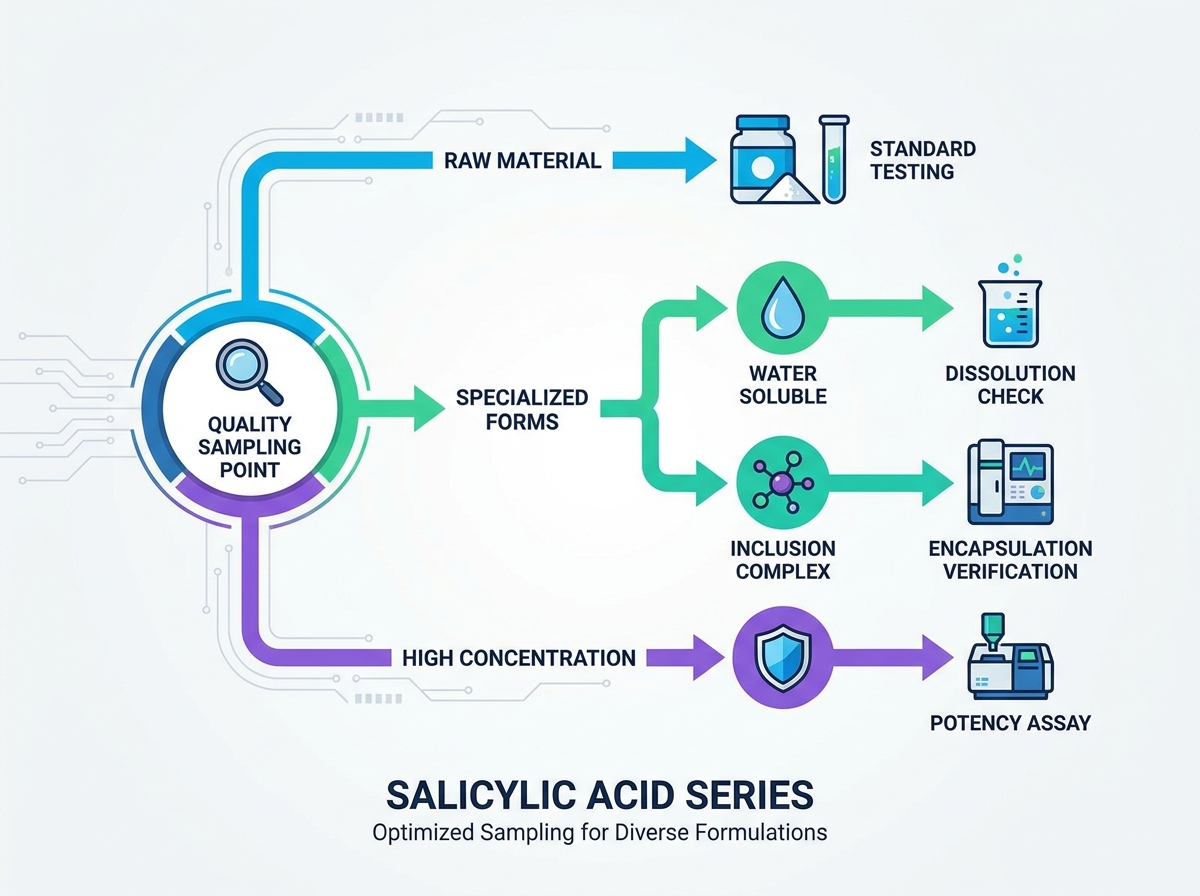
In pharmaceutical and high-tier cosmetic manufacturing, raw material variability is a primary driver of batch failure. Inconsistent sampling of active pharmaceutical ingredients directly compromises downstream formulation stability and chemical synthesis yields. Achieving the stringent USP/EP assay specifications requires flawless execution. Improper sampling techniques, inadequate environmental controls, or failure to account for matrix effects in modified derivatives often lead to false out-of-specification (OOS) results, delayed production timelines, and supplier disputes. Furthermore, compromised raw materials can severely impact downstream processes, such as the synthesis of acetylsalicylic acid or advanced dermatological treatments. Establishing a robust, scientifically validated sampling and analytical framework is mandatory. This guide breaks down the technical evaluation criteria, sampling protocols, and analytical methodologies required to accurately assess standard and specialized grades of the Salicylic Acid Series.
Baseline requirements for USP, EP, and ACS/reagent-grade classifications form the foundation of incoming quality control. The United States Pharmacopeia dictates a strict assay range of 99.5% to 101.5% calculated on a dried basis. Falling outside this narrow margin triggers immediate quarantine protocols. You cannot simply retest a failing batch until it passes; an out-of-specification result halts production lines and initiates a formal deviation investigation. Evaluating supplier Certificates of Analysis (CoA) against internal laboratory results requires meticulous attention to the specific test methods used. Discrepancies frequently arise from differing sample preparation techniques or moisture calculation errors rather than actual material degradation.
ACS/reagent-grade material serves a dual role in modern analytical laboratories. We test it rigorously as an incoming raw material, but it also functions as a high-purity reference standard for other assays. Analysts rely heavily on this specific grade for calibrating internal titrations, standardizing 0.1 N sodium hydroxide solutions, and establishing baseline calibration curves for complex analytical testing procedures. Maintaining the integrity of these reference standards guarantees the accuracy of all subsequent batch testing.
Identifying common synthetic byproducts is a daily reality for quality control teams. Phenol, 4-hydroxybenzoic acid, and 4-hydroxyisophthalic acid represent the most frequent impurities found in these chemical batches, often carrying over from incomplete Kolbe-Schmitt carboxylation reactions. Specific trace impurities directly interfere with downstream chemical synthesis. During Aspirin production, excess phenol triggers unwanted side reactions, reducing overall yield and introducing toxicological risks. In cosmetic emulsions, these same trace impurities disrupt phase stability, alter product color over time, and compromise the efficacy of the final formulation.
Acceptable limits for heavy metals, loss on drying (LOD), and residue on ignition (ROI) must align perfectly with strict pharmacopeial monographs. Physical parameters require equal scrutiny before any chemical analysis begins. Analysts verify appearance, crystalline structure, and melting point. A precise melting point determination (typically 158°C to 161°C) confirms the absence of significant moisture or gross structural contamination. A depressed melting point serves as an immediate indicator of compromised purity before you advance to resource-intensive chromatographic analysis.
Pharmacopeial Specification Limits
| Parameter | Standard USP Limit | Testing Methodology |
|---|---|---|
| Assay (Dried Basis) | 99.5% - 101.5% | HPLC or Acid-Base Titration |
| Loss on Drying (LOD) | < 0.5% | Gravimetric (Silica Gel Desiccator, 3 hours) |
| Residue on Ignition | < 0.05% | Muffle Furnace (800°C) |
| Heavy Metals | < 20 ppm | Colorimetric or ICP-MS |
| Phenol Content | < 0.002% | HPLC with UV Detection |
Applying rigorous statistical sampling plans ensures representative batch analysis and eliminates selection bias on the warehouse floor. Quality control teams typically utilize ANSI/ASQ Z1.4 acceptable quality limit frameworks or the WHO √n+1 guideline to determine the exact number of containers to sample per raw material lot. If you receive a shipment of 100 drums, this mathematical approach dictates sampling from 11 distinct containers. Executing top, middle, and bottom core sampling within individual bulk drums accounts for settling and physical stratification.
Powders naturally segregate during transit based on particle size, density, and vibration exposure. Finer particles drop to the bottom of the drum, while larger agglomerates remain near the surface. Pulling samples from multiple depths using specialized equipment guarantees a composite sample that accurately reflects the entire container. Failing to stratify the sampling process skews assay results and generates false purity readings.
Sampling environments demand strict ISO classifications to prevent airborne contamination and protect material integrity. Utilizing Class 100 or ISO 5 sampling booths provides a controlled, unidirectional airflow that sweeps particulates away from the open container. This positive pressure environment prevents cross-contamination between different raw material batches processed in the same facility. Selecting appropriate inert sampling tools is equally critical.
Technicians use 316L stainless steel or PTFE-coated concentric thieves to extract the powder. Avoiding reactive materials prevents trace metal contamination, which catalyzes degradation or skews subsequent heavy metal assay results. All sampling tools undergo validated cleaning procedures and visual inspections before contacting the raw material to ensure zero carryover from previous sampling events.
Handling high concentration salicylic acid requires specific mitigation strategies for airborne dust exposure and static charge accumulation. Fine, high-purity powders easily become airborne during sample transfer, posing inhalation risks to operators and contaminating adjacent laboratory surfaces. Grounding sampling equipment neutralizes static electricity, ensuring the powder flows freely into the sample vessel without clinging to the thief or the drum liner.
Proper storage and desiccation techniques for retained samples prevent moisture ingress prior to testing. Technicians seal samples in airtight, light-resistant containers and store them in controlled desiccators immediately after extraction. This preserves the material's integrity for accurate loss on drying determinations and prevents ambient humidity from altering the dried basis assay calculations.
High-Performance Liquid Chromatography serves as the definitive method for quantifying active content and profiling impurities. Standard parameters for HPLC analysis include selecting a robust C18 column (typically 150 mm x 4.6 mm, 5 µm particle size), optimizing the mobile phase composition, and maintaining a precise flow rate of 1.0 mL/min. A common mobile phase consists of a mixture of water, methanol, and glacial acetic acid. Calibrating UV detectors around 237 nm ensures optimal absorption and baseline stability for this specific molecular structure. Proper wavelength selection maximizes the signal-to-noise ratio.
Validation parameters strictly adhere to ICH Q2(R1) guidelines for analytical procedures. Analysts prove specificity, linearity, range, accuracy, and precision through rigorous documentation. The method demonstrates the absolute ability to separate and determine the content of individual unknown impurities in new formulations. This ensures that degradation products or synthetic byproducts do not co-elute with the main active peak, which would artificially inflate the reported assay value.
Traditional acid-base titration methods remain common for preliminary assay testing and total acid content verification. However, procedural errors in sample preparation frequently lead to incomplete dissolution and highly inaccurate titration endpoints. Technicians struggle with visual endpoint detection when the solute remains partially undissolved in the titration vessel. Establishing strict standard operating procedures for dissolution resolves these persistent issues.
Analysts utilize an Erlenmeyer flask rather than a standard beaker to minimize solvent evaporation during the heating phase. Heating a large quantity of neutralized ethanol to its boiling point and incrementally adding the hot solvent to the sample guarantees complete solute dispersion. This meticulous preparation yields sharp, reproducible titration endpoints when using indicators like phenol red, eliminating the subjective errors associated with sluggish color changes.
Analyzing the solubility profile is a critical prerequisite for accurate analytical testing. Standard grades exhibit distinct solubility behaviors in various organic solvents like ethanol, methanol, and ether compared to their limited solubility in cold water (approximately 1 gram dissolves in 460 mL of water, whereas 1 gram dissolves in just 3 mL of ethanol). Solvent selection directly impacts extraction efficiency and the accuracy of subsequent chromatographic injections. Utilizing an incompatible solvent leads to peak splitting, poor column retention, or precipitation within the HPLC system.
Ethanol and methanol provide rapid, complete dissolution for standard grades, ensuring the entire sample volume transfers accurately onto the HPLC column. Analysts verify that the chosen extraction solvent is fully miscible with the HPLC mobile phase to prevent localized precipitation at the column head, which rapidly degrades column lifespan and compromises system suitability metrics.
Solvent Selection Matrix
| Solvent Type | Solubility Profile | Primary Lab Application |
|---|---|---|
| Purified Water (Cold) | Poor (1g / 460 mL) | Aqueous mobile phase component (requires buffering). |
| Purified Water (Boiling) | Moderate (1g / 15 mL) | Hot extractions; recrystallization procedures. |
| Ethanol (95%) | Excellent (1g / 3 mL) | Primary solvent for acid-base titration preparation. |
| Methanol | Excellent (1g / 3 mL) | Standard diluent for HPLC sample preparation. |
| Diethyl Ether | Good (1g / 3 mL) | Liquid-liquid extraction of trace impurities. |
Structural modifications or salt formations designed to create water soluble salicylic acid fundamentally alter the expected analytical profile. These engineered variants require distinct testing parameters compared to standard raw materials. Analysts implement necessary adjustments to mobile phase pH in HPLC workflows to account for the altered pKa of the modified molecule. Standard unbuffered mobile phases will not yield acceptable chromatography for these variants.
Failing to buffer the mobile phase correctly results in severe peak tailing, unpredictable retention time shifts, or split peaks. The ionized state of the modified molecule interacts differently with the stationary phase of the C18 column. Precise pH control, utilizing phosphate or acetate buffers, is mandatory to maintain peak symmetry, ensure reproducible retention times, and allow for accurate automated integration.
The structural nature of inclusion complexes complicates standard analytical workflows significantly. A salicylic acid inclusion complex encapsulates the active molecule within a protective host cavity, altering its physical and chemical behavior. Standard direct-dissolution methods fail to yield accurate active ingredient assays because the active compound remains trapped within the host structure. Injecting this directly yields artificially low results.
Analysts execute required dissociation techniques to release the active molecule prior to analysis. This involves targeted sonication, specific organic-to-aqueous solvent ratios, or controlled thermal disruption. Breaking the non-covalent bonds between the host and guest molecules ensures the entire active payload is available for chromatographic quantification. Validation of this dissociation step proves complete recovery of the active ingredient.
Executing a step-by-step sample preparation workflow is mandatory when analyzing a cyclodextrin salicylic acid complex. The extraction process begins with dispersing the complex in an organic solvent mixture specifically designed to disrupt the cyclodextrin ring structure. Extended sonication under controlled temperatures forces the release of the guest molecule into the surrounding solvent.
Once dissociation occurs, technicians precipitate or filter out the cyclodextrin matrix. Removing this bulky carbohydrate matrix protects instrument health. If injected directly, residual cyclodextrin causes severe HPLC column clogging, elevates backpressure to critical levels, and creates massive matrix interference during UV detection. High-speed centrifugation at 10,000 RPM followed by 0.22-micron PTFE filtration provides a clean, particle-free sample matrix for accurate injection.
Identifying the root causes of OOS results requires a systematic, documented approach. Many failures stem from analytical error, matrix interference, or improper sample preparation rather than actual raw material degradation. Matrix interference from excipients or incomplete extraction mimics low assay results, leading to unnecessary batch rejection. Laboratories deploy a strict decision matrix for investigating false fails using phase 1 laboratory investigations.
This investigation protocol includes running immediate system suitability checks to verify instrument performance. Analysts perform blank injections to rule out carryover from previous runs and execute standard recovery tests. Spiking a known quantity of reference standard into the sample matrix verifies whether the extraction protocol genuinely recovers the active compound or if the matrix suppresses the UV signal.
Evaluating the trade-offs between rapid screening and highly accurate methods optimizes laboratory efficiency and reduces release times. High-throughput screening methods like Fourier Transform Near-Infrared (FT-NIR) spectroscopy offer immediate identification, preliminary moisture analysis, and structural confirmation without sample destruction. However, time-intensive, highly accurate methods like HPLC remain strictly necessary for definitive batch release, precise assay quantification, and comprehensive impurity profiling.
Optimizing laboratory throughput involves using FT-NIR for routine incoming inspection of established, low-risk suppliers. Laboratories reserve HPLC for new supplier qualification, complex formulations, periodic verification, or investigating out-of-trend FT-NIR results. This tiered analytical approach maintains the strict compliance required for pharmaceutical-grade raw materials without creating massive analytical bottlenecks in the QA/QC department.
Conducting inter-laboratory comparisons with the raw material manufacturer ensures long-term consistency and reduces supply chain friction. Round-robin testing frequently reveals subtle discrepancies in sample preparation, solvent selection, or instrument calibration between the supplier's facility and the buyer's laboratory. Establishing protocols for aligning internal testing methods with the supplier's validated methods guarantees CoA reproducibility.
When both laboratories utilize identical extraction solvents, matched sonication times, and synchronized HPLC parameters, the risk of disputed OOS results drops significantly. Regular technical audits of the supplier's analytical facility further solidify this alignment. QA managers mandate the sharing of full method validation reports, including chromatograms and system suitability data, to ensure complete transparency before approving a new raw material source.
A: The United States Pharmacopeia requires an assay range of 99.5% to 101.5% calculated on a dried basis. Achieving this precision demands highly accurate titration or validated HPLC methods to prevent false out-of-specification results during routine batch release.
A: Testing a complex requires a specific dissociation step using targeted solvents and sonication to release the active acid from the cyclodextrin cavity before quantification. Standard dissolution leaves the active trapped, leading to artificially low assay results and severe matrix interference.
A: HPLC separates, identifies, and quantifies individual unknown impurities and synthetic byproducts like phenol. Titration only provides a total acid content measurement, making it impossible to detect trace degradation products that could disrupt downstream manufacturing.
A: Alcohols such as ethanol or methanol provide rapid and complete dissolution for standard high-concentration powders. These solvents ensure efficient extraction prior to dilution in the mobile phase, preventing incomplete solute dispersion and skewed chromatographic results.
A: Utilizing ISO Class 100 or ISO 5 sampling booths prevents airborne cross-contamination. Controlled airflow and inert sampling tools ensure the pulled sample remains pristine, preventing trace metal or particulate interference during subsequent analytical testing.
A: Structural modifications alter the molecule's ionization state and pKa. Adjusting the mobile phase pH with specific buffers prevents peak tailing and unpredictable retention time shifts, ensuring accurate integration and reproducible chromatographic results.


