

close
Choose Your Site
Global
Social Media
Views: 0 Author: Site Editor Publish Time: 2026-08-14 Origin: Site


Formulation scientists face a persistent bottleneck when developing biopolymer-based nanocarriers. While modern pharmacokinetics demands excipients with high biocompatibility and functional versatility, raw, unmodified chitosan often fails at the bench. It presents severe solubility constraints at physiological pH. Furthermore, unpredictable batch-to-batch variability frequently derails clinical efficacy, bioavailability, and regulatory approval for targeted drug delivery systems. We need materials that do not trigger immune responses or inflammation. Overcoming these formulation hurdles requires a strict evaluation of specific physicochemical properties. Molecular weight, degree of deacetylation, and chemical modifications directly dictate carrier performance. Selecting the optimal grade from a reliable Pharmaceutical Excipient Chitosan Series ensures controlled release, stability, and scale-up viability. This guide breaks down exactly which properties influence drug carrier performance and how formulation teams leverage them to move from pilot testing to clinical success.
Successful drug carriers must meet stringent baseline technical requirements before advancing to animal models or clinical trials. Formulation scientists prioritize high encapsulation efficiency (EE%) to minimize active pharmaceutical ingredient (API) waste during manufacturing. When we design a carrier matrix, it must provide predictable sustained release profiles tailored to the specific therapeutic window of the drug. Preserving the API during transit through hostile physiological environments remains paramount. Biopolymers must shield sensitive payloads, such as peptides or mRNA, from enzymatic degradation and extreme pH fluctuations in the gastrointestinal tract or bloodstream.
Achieving these objectives requires precise control over the polymer network structure. Crosslinking density directly influences how quickly the matrix swells and releases the encapsulated drug. Developers must align these physical characteristics with the intended route of administration. We evaluate success based on the following primary metrics:
Chitosan stands out among natural polymers due to its inherent cationic nature. The pKa of its primary amino groups hovers around 6.5. Protonation of these groups occurs readily in acidic environments, granting the polymer a strong positive charge. This positive charge allows the polymer to interact electrostatically with negatively charged surfaces. Mucin glycoproteins, which line the respiratory, gastrointestinal, and reproductive tracts, contain abundant sialic acid residues carrying negative charges. Electrostatic attraction between the protonated polymer and mucosal surfaces forms the basis for exceptional mucoadhesion.
This mechanism extends the residence time of the drug carrier at the absorption site, allowing for higher local drug concentrations. The cationic charge also enables the complexation of negatively charged drug molecules, particularly nucleic acids and certain proteins. Formulation teams leverage this property to control release rates and improve cellular uptake across various delivery modalities. When we measure zeta potential in the lab, a strong positive reading confirms that the amino groups are adequately protonated and ready for mucosal interaction.
In vivo safety dictates the ultimate viability of any pharmaceutical excipient. The carrier must perform its beneficial functions without inducing immune responses, oxidative stress, or localized inflammation. Native grades demonstrate excellent biocompatibility across multiple administration routes. The human body possesses specific enzymes capable of breaking down this biopolymer naturally. Lysozyme, present in tears, saliva, and blood serum, cleaves the beta-1,4-glycosidic bonds within the polymer backbone.
This enzymatic action degrades the carrier into non-toxic oligosaccharides and monosaccharides. Glucosamine represents the primary degradation product, which integrates seamlessly into normal metabolic pathways. The renal system clears these natural metabolites efficiently without causing systemic toxicity, provided the molecular weight of the degradation fragments falls below the renal filtration threshold of approximately 30 to 50 kDa. Establishing strict criteria for degradation rates ensures the carrier does not accumulate inappropriately within host tissues after repeated dosing.
The Degree of Deacetylation (DDA) fundamentally dictates the chemical behavior of the polymer. DDA represents the balance between free amino groups and acetylated residues along the carbon chain. A higher DDA indicates a greater number of primary amines available for protonation. This structural shift increases the positive charge density of the molecule. High charge density significantly enhances mucoadhesion and improves DNA binding efficiency. We typically use nuclear magnetic resonance (NMR) spectroscopy or potentiometric titration to verify the exact DDA before starting any formulation work.
However, DDA also alters the enzymatic degradation rate. Lysozyme specifically targets the acetylated residues within the polymer structure. Highly deacetylated grades (above 90%) resist enzymatic breakdown much longer than their low-DDA counterparts (around 70%). Formulation scientists manipulate this ratio to tune the in vivo lifespan of the drug carrier. If you need a rapidly degrading scaffold for tissue engineering, a lower DDA works best. If you need a long-circulating nanoparticle, a higher DDA provides the necessary structural integrity.
Impact of DDA on Formulation Characteristics
| DDA Range | Charge Density | Lysozyme Degradation Rate | Primary Application |
|---|---|---|---|
| 70% - 80% | Low to Moderate | Rapid | Short-term release matrices, wound dressings |
| 80% - 90% | High | Moderate | Standard mucosal nanoparticles, oral delivery |
| > 90% | Very High | Slow | Gene delivery vectors, long-term implants |
Molecular weight variations drastically impact the physical properties of the resulting formulation. We measure Mw in kilodaltons (kDa) using gel permeation chromatography (GPC). High-Mw grades (greater than 300 kDa) form highly viscous solutions even at low concentrations. These long polymer chains create robust, entangled matrices ideal for prolonged drug release. Tablets and hydrogels often utilize high-Mw grades to sustain API delivery over extended periods, as the dense network slows down fluid penetration and subsequent drug diffusion.
Conversely, low-Mw grades (under 50 kDa) offer superior aqueous solubility. Shorter chains reduce solution viscosity, facilitating easier processing during manufacturing. Nanoparticle synthesis frequently relies on low-Mw grades to achieve tight particle size distributions. Smaller polymer chains also demonstrate better intracellular penetration, making them highly effective for delivering therapeutics directly into the cytoplasm. Selecting the correct molecular weight determines both the manufacturing feasibility and the ultimate release kinetics of the final dosage form.
Evaluating purity parameters remains non-negotiable for clinical compliance. The polymer acts as a natural chelating agent. It readily absorbs toxic heavy metals like lead, arsenic, and mercury during its extraction from raw crustacean shells or fungal biomass. Residual proteins from the source material can easily compromise carrier stability. More importantly, these impurities can trigger severe adverse immune responses in patients, leading to anaphylaxis or localized tissue necrosis.
Ash content provides a direct measurement of residual inorganic materials, which we typically keep below 1.0% for pharmaceutical applications. Endotoxin limits require rigorous monitoring, especially for parenteral formulations. High endotoxin levels induce fever and systemic inflammation. For intravenous applications, endotoxin levels must strictly remain below 0.1 EU/mg. Manufacturers must implement rigorous purification protocols, including multiple precipitation and filtration steps, to remove these contaminants. Only highly purified grades meet the strict safety thresholds required by global pharmacopeias.
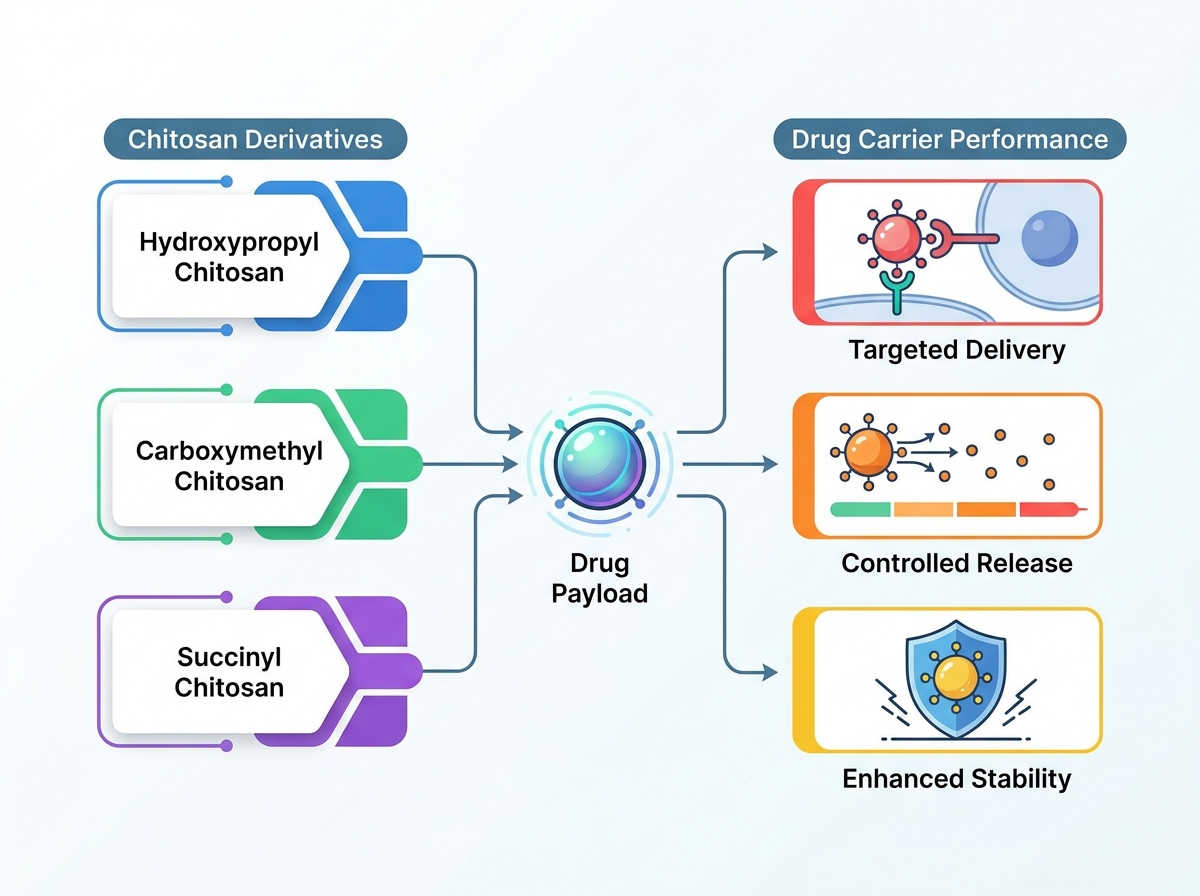
Native grades suffer from poor solubility at neutral and alkaline pH levels. This limitation restricts its use in physiological environments where pH exceeds 6.5, such as the bloodstream or the lower intestinal tract. Introducing hydroxypropyl groups via reaction with propylene oxide directly disrupts the rigid crystalline structure of the polymer backbone. This chemical modification prevents the strong intermolecular hydrogen bonding that normally causes the polymer chains to aggregate and precipitate out of solution.
As a result, hydroxypropyl chitosan achieves excellent water solubility across a broad pH range. This enhanced solubility significantly improves the bioavailability of poorly soluble drugs. The derivative maintains excellent film-forming traits and optical clarity. Formulation scientists frequently select this grade for transdermal patches and ocular drops. In ocular delivery, maintaining a neutral pH of 7.4 is mandatory to prevent tissue irritation and excessive tearing, which would otherwise wash away the API before absorption occurs.
Oral drug delivery presents unique challenges due to the extreme pH variations within the gastrointestinal tract. Adding monochloroacetic acid to the polymer structure creates an amphoteric molecule. This derivative contains both positive amino groups and negative carboxyl groups. Depending on the reaction conditions, we can synthesize O-carboxymethyl, N-carboxymethyl, or N,O-carboxymethyl variants, each offering distinct isoelectric points.
The resulting carboxymethyl chitosan exhibits unique pH-dependent swelling behavior. In the highly acidic environment of the stomach (pH 1.2 to 2.0), the matrix shrinks and tightens, protecting sensitive APIs like peptides or probiotics from enzymatic degradation. Upon reaching the neutral pH of the intestines (pH 6.8 to 7.4), the carboxyl groups ionize, causing the polymer network to swell rapidly due to electrostatic repulsion. This swelling triggers the targeted release of the encapsulated drug exactly where absorption is optimal. The derivative also provides mild antacid effects, further shielding the payload from gastric damage.
Systemic targeted delivery requires carriers capable of evading rapid immune clearance by the reticuloendothelial system (RES). Succinylation introduces bulky negative charges onto the polymer chain through reaction with succinic anhydride. This structural change fundamentally alters the pharmacokinetic profile of the carrier. The negative charge shifts the zeta potential, reducing non-specific electrostatic interactions with negatively charged blood proteins and cell membranes.
Succinyl chitosan demonstrates significantly longer systemic circulation times compared to native grades. Prolonged circulation allows nanoparticles to accumulate more effectively in targeted tissues, leveraging the Enhanced Permeability and Retention (EPR) effect commonly observed in solid tumors. The modification also lowers the inherent cytotoxicity of the polymer. Reduced toxicity makes this derivative highly suitable for intravenous administration where safety margins remain extremely tight and off-target effects must be minimized.
The ionotropic gelation method remains the gold standard for producing biopolymer nanoparticles in the lab. This technique relies on the electrostatic interaction between cationic polymer chains and anionic crosslinkers. Sodium tripolyphosphate (TPP) serves as the most common crosslinking agent. When we formulate these particles, we add the TPP solution dropwise into the polymer solution under continuous magnetic stirring, typically around 800 to 1000 RPM.
Formulation scientists must meticulously optimize the mass ratio of polymer to TPP. We often target a 3:1 to 5:1 ratio. This ratio dictates the crosslinking density within the particle matrix. Proper optimization controls the final particle size, keeping it between 150 and 300 nanometers, and minimizes the polydispersity index (PDI). A narrow PDI ensures uniform drug release across the entire dose. Adjusting the crosslinker concentration also helps mitigate burst release phenomena. Controlling burst release prevents initial drug toxicity and extends the sustained therapeutic effect over several days or weeks.
Transmucosal administration routes offer direct access to systemic circulation while bypassing hepatic first-pass metabolism. Nasal, buccal, sublingual, and pulmonary delivery systems require excipients capable of penetrating dense mucosal barriers. Cationic polymers excel in these applications by interacting directly with epithelial cell structures. The polymer transiently opens tight junctions between adjacent epithelial cells by interacting with the ZO-1 tight junction protein.
This temporary modulation allows large therapeutic molecules, such as insulin or monoclonal antibodies, to pass through the mucosal lining via the paracellular route. Reversible tight junction opening maximizes systemic absorption without causing permanent tissue damage or compromising the barrier function long-term. Formulation teams select high-DDA grades to ensure maximum interaction with these cellular barriers. The resulting formulations achieve rapid onset of action for critical therapeutic interventions, such as pain management or emergency hormone delivery.
In topical applications, the excipient functions as an active participant rather than a mere inert carrier. The polymer exhibits intrinsic antibacterial properties against a wide spectrum of pathogens, including Staphylococcus aureus and Escherichia coli. The protonated amino groups bind to the negatively charged bacterial cell walls, disrupting membrane permeability and leading to cell death. This inherent antimicrobial action reduces the need for synthetic preservatives in the formulation.
Furthermore, the material actively accelerates the wound healing cascade. It promotes hemostasis by inducing red blood cell agglutination. It stimulates fibroblast proliferation and promotes rapid tissue granulation. We often formulate it into hydrogels or electrospun nanofibers for burn treatments. Some derivatives also demonstrate potential antitumor synergies when applied to localized skin lesions. Leveraging these biological properties creates highly effective, multifunctional topical therapies for severe dermatological conditions and chronic diabetic ulcers.
Gene therapy requires robust vectors capable of transporting fragile nucleic acids into target cells. Viral vectors present significant immunogenicity risks, limited payload capacities, and complex manufacturing requirements. Cationic biopolymers offer a safer, non-viral alternative for gene delivery. The high positive charge density allows the polymer to condense plasmid DNA and siRNA into compact nanoparticles through electrostatic complexation. We measure this efficiency using the N/P ratio, which compares the moles of polymer amines (N) to nucleic acid phosphates (P).
This complexation protects the nucleic acids from rapid nuclease degradation in the bloodstream. Once internalized by the target cell via endocytosis, the polymer facilitates endosomal escape. The "proton sponge effect" causes the endosome to absorb water and rupture, releasing the genetic payload safely into the cytoplasm before it degrades in the lysosome. Selecting specific low-toxicity, low-Mw grades ensures high transfection efficiency without compromising cell viability.
Naturally derived polymers inherently suffer from batch-to-batch variability. Environmental factors affecting the source material—whether shrimp shells, crab shells, or fungal mycelium—alter the final polymer characteristics. Variations in molecular weight and deacetylation directly impact formulation consistency, altering viscosity, particle size, and release kinetics from one batch to the next. Formulation scientists must establish a rigorous framework for evaluating raw material suppliers.
Procurement teams should demand comprehensive standardization processes from their vendors. Certificate of Analysis (CoA) reliability serves as the first line of defense against inconsistent materials. Source traceability ensures the raw material originates from controlled, sustainable environments. Implementing strict internal quality control testing, such as running GPC and NMR on every incoming batch, prevents out-of-specification excipients from entering the manufacturing pipeline and ruining expensive API payloads.
Balancing mucoadhesion against systemic stability presents a significant formulation trade-off. High mucoadhesion requires a strong positive charge density. However, this same positive charge increases the risk of premature aggregation in the bloodstream. Cationic particles can bind non-specifically to negatively charged serum proteins, a process known as opsonization. This interaction causes rapid clearance by the reticuloendothelial system before the drug reaches its target.
Formulation teams employ specific mitigation strategies to overcome this hurdle. Surface PEGylation shields the positive charge, creating a hydrophilic corona that prevents protein adsorption. Alternatively, utilizing specific pharmaceutical chitosan derivatives alters the surface chemistry entirely. These modifications maintain targeted delivery capabilities while ensuring robust stability under complex physiological conditions, preventing salt-induced aggregation in high-ionic-strength environments like blood plasma.
Moving a formulation from bench-scale research to commercial manufacturing introduces severe regulatory hurdles. Regulatory agencies require exhaustive documentation regarding excipient safety, purity, and manufacturing controls. Scale-up processes often alter the physical characteristics of the nanoparticles. Shear forces during large-scale mixing or high-pressure homogenization can degrade polymer chains, alter particle size distributions, and prematurely release the encapsulated drug.
Selecting excipients with established Drug Master Files (DMF) significantly accelerates the approval process. A DMF provides regulators with confidential, detailed information about the excipient's manufacturing, purification, and quality control directly from the supplier. Formulation teams must prioritize materials with clear regulatory pathways. Achieving GRAS (Generally Recognized As Safe) status or strict pharmacopeial compliance minimizes commercialization risks and prevents costly delays during Phase III clinical trials.
To implement these formulation strategies effectively and move your drug delivery system toward clinical viability, execute the following steps:
A: The optimal DDA depends entirely on your specific formulation goals. High DDA grades (above 85%) provide maximum positive charge density. This high charge improves mucoadhesion and enhances nucleic acid complexation. Lower DDA grades generally degrade faster in vivo. Formulation scientists must balance charge requirements against desired release kinetics.
A: Native grades precipitate at neutral pH, trapping the drug. Derivatives like hydroxypropyl modifications disrupt the polymer's crystalline structure. This chemical change ensures complete aqueous solubility across a broad pH range. Enhanced solubility allows the carrier matrix to dissolve properly in physiological fluids, releasing the API efficiently.
A: Carboxymethyl modifications create an amphoteric polymer containing both positive and negative charges. This structure shrinks in the acidic stomach environment, protecting sensitive drugs from degradation. Upon reaching the neutral intestines, the polymer swells rapidly. This pH-responsive swelling triggers targeted drug release exactly where absorption is highest.
A: High molecular weight chains create highly viscous solutions and dense, entangled matrices. These robust networks slow down fluid penetration, resulting in prolonged, sustained drug release. Low molecular weight grades form less viscous solutions. They dissolve faster and are preferred for synthesizing small nanoparticles with rapid release profiles.
A: Yes. Succinylation introduces negative charges that mask the inherent cationic nature of the polymer. This modification prevents non-specific binding with blood proteins. The resulting nanoparticles exhibit significantly longer systemic circulation times. Prolonged circulation allows the carrier to accumulate effectively within tumor microenvironments.
A: Scientists mitigate this risk by partnering with suppliers who enforce rigorous standardization processes. Procurement teams must demand comprehensive Certificates of Analysis (CoAs) for every batch. Tracking source traceability and implementing strict internal testing for DDA and molecular weight ensures consistent performance across manufacturing runs.


