

close
Choose Your Site
Global
Social Media
Views: 0 Author: Site Editor Publish Time: 2026-10-14 Origin: Site


In the rapidly evolving landscape of clean beauty and sustainable formulations, finding a reliable, natural film former has become a top priority for cosmetic chemists and research and development teams. As consumer awareness regarding environmental impact grows, synthetic polymers that once dominated lab benches are rapidly being replaced by biodegradable alternatives. Consequently, the chitosan series has emerged as a frontrunner in natural formulation chemistry. Derived from chitin, this versatile biopolymer offers exceptional film-forming capabilities, high biocompatibility, and impressive moisture-retaining properties. However, seamlessly replacing established synthetic polymers with natural biopolymers requires rigorous prototype testing. Formulators must ensure the final product not only aligns with green standards but also meets strict consumer expectations for texture, durability, and overall performance on the skin or hair. This comprehensive guide explores how to effectively test chitosan as a film former in cosmetic prototypes, detailing specific testing protocols for various derivatives and offering actionable insights to optimize your formulations for commercial market success.
Versatile Natural Polymer: Chitosan offers a sustainable, biodegradable alternative to synthetic film formers like polyvinylpyrrolidone or silicones in personal care cosmetics.
Derivative Selection is Crucial: Choosing the right functional modification dictates the solubility, mechanical flexibility, and moisture-binding capacity of the resulting cosmetic film.
Rigorous Testing Protocols: Successful cosmetic prototypes require comprehensive empirical laboratory testing for film flexibility, substrate adhesion, breathability, and long-term formulation stability.
Application-Specific Performance: Hair care prototypes prioritize substantivity and flake resistance, while skin care prototypes focus on breathability, barrier protection, and sensory feel.
Formulation Compatibility: Testing for pH stability and rheological behavior is absolutely essential to prevent common prototype failures like polymer precipitation, phase separation, or unwanted cloudiness.
The cosmetic industry is currently undergoing a structural shift driven by consumer demand and mounting regulatory pressures. Traditional synthetic film formers, such as acrylates and volatile silicones, are facing intense environmental scrutiny due to their persistence in aquatic ecosystems. Recent industry analyses regarding cosmetic biopolymers highlight a critical turning point: regulatory bodies are strictly phasing out intentionally added microplastics and non-biodegradable polymers in both rinse-off and leave-on cosmetics. This regulatory wave is forcing a fundamental change in how R&D teams approach ingredient selection.
Market insights suggest that brands adopting biodegradable film formers early are capturing significant market share among eco-conscious consumers. By integrating high-quality cosmetic grade chitosan, your formulation strategy moves from a simple ingredient swap to a long-term compliance and performance advantage. This biopolymer stands out due to its natural cationic charge in slightly acidic environments, allowing it to bind effectively to negatively charged surfaces like skin and hair fibers through electrostatic interactions. It creates a breathable, non-occlusive protective mesh that prevents transepidermal water loss without disrupting the microbiome.
To create a successful prototype, formulators must select the correct derivative based on the target application. While unmodified natural chitosan is effective, it typically requires an acidic environment to dissolve, which limits formulation flexibility. Fortunately, functional derivatives resolve this solubility issue while introducing performance characteristics that synthetic polymers often struggle to match.
Hydroxypropylation introduces bulky functional groups to the chitosan backbone, disrupting hydrogen bonding and significantly increasing water solubility across a broader pH range. Formulating with hydroxypropyl chitosan cosmetics yields highly flexible, transparent films. Because this derivative does not rely heavily on acidic dissolution, it is the ideal choice for clear hair styling gels and nail care prototypes where a non-brittle, optically clear finish is mandatory.
Carboxymethylation converts chitosan into an amphoteric polymer, allowing it to carry both positive and negative charges depending on environmental pH. This targeted modification enhances moisture-retention capabilities. Incorporating carboxymethyl chitosan cosmetics into anti-aging creams and serums helps maintain skin integrity by creating a biomimetic hydration barrier that provides long-lasting moisture without a greasy sensory profile.
Lastly, for formulations requiring high-level substantivity, such as leave-in hair conditioners or protective barrier lotions, chitosan succinamide is an excellent candidate. This derivative forms a cohesive, wash-off resistant film that provides a lubricious, smooth feel, shielding the substrate from environmental stressors.
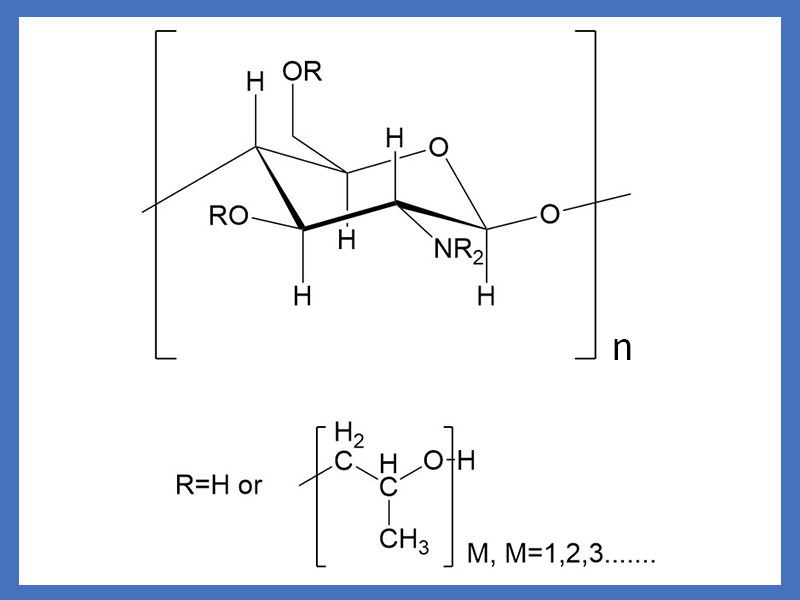
Once you have selected the appropriate derivative, rigorous physical and mechanical testing is mandatory to ensure real-world efficacy. Bench chemists must observe how the polymer behaves under stress rather than relying solely on theoretical data.
A cosmetic film must withstand the mechanical stress of constant movement. In the lab, researchers cast films of standardized thickness onto glass or Teflon plates. After curing in a climate-controlled chamber, the free films are peeled off for evaluation. A texture analyzer is then used to measure tensile strength and elongation at break. The primary objective is to ensure the film exhibits a low Young's modulus, which indicates high flexibility. A brittle film will inevitably flake when applied to dynamic areas like the face or hair.
Furthermore, adhesion and substantivity analysis is vital. For hair care, substantivity is often quantified using standardized hair tress wash-out tests. Swatches are treated, rinsed, and analyzed to determine remaining polymer deposition. For skin care, tape stripping tests are employed, where adhesive tape is applied to the treated patch and analyzed to determine how effectively the barrier adheres to the stratum corneum. These methods provide concrete proof of the prototype's durability.
A film former must perform on the body and remain stable inside the packaging over a multi-year shelf life. The addition of chitosan derivatives significantly alters the flow behavior of a cosmetic base. Prototypes must undergo rheological profiling to measure viscosity across different shear rates, ensuring the product maintains the desired shear-thinning behavior—allowing for easy pumping while staying in place upon application.
Polymer solubility is heavily dependent on pH, so your testing regimen should include pH titration to identify exactly where the chitosan might precipitate or lose its film-forming efficacy. Advanced derivatives generally allow formulators to work comfortably within the physiological skin pH range of 4.5 to 5.5 without risking phase separation. Additionally, keep an eye on interactions with anionic ingredients like surfactants or certain thickeners. Incompatible blends often lead to coacervation, where oppositely charged polymers form insoluble clumps. Always test mixing orders and consider non-ionic co-ingredients to maintain system stability.
Performance criteria vary drastically depending on the target application, requiring tailored testing protocols. Hair care products require films that provide structural hold without compromising fluid movement. In this space, High Humidity Curl Retention testing is paramount; treated tresses are curled and hung in a humidity chamber to observe how well the film prevents curl drop over 24 hours. Additionally, combability testing helps measure the frictional force required to manage wet or dry hair.
In contrast, skin care requires films that are imperceptible, comfortable, and deeply hydrating. Measuring transepidermal water loss reduction with a Tewameter is the industry standard for validating barrier function. Sensory panel testing is also necessary to evaluate the tackiness during the dry-down phase, as consumer acceptance hinges on a non-greasy finish. For peel-off mask prototypes, tear strength testing ensures the mask can be removed in a single piece.
Even experienced chemists encounter challenges when working with natural biopolymers. If a prototype leaves a white, flaky residue on the skin or hair, it indicates the film is too brittle. The solution is to introduce natural plasticizers like glycerin, propanediol, or sorbitol. These ingredients intercalate between polymer chains, increasing free volume and elasticity.
If your clear gel turns turbid, the cause is usually incomplete hydration, a pH mismatch, or an electrostatic conflict. Adjusting processing parameters, such as extending hydration time or optimizing temperature, often fixes the issue. If that fails, switching to a highly purified, inherently water-soluble derivative typically restores optical clarity. Finally, if excessive stickiness occurs, try adjusting the molecular weight of the chitosan or blending it with secondary natural polymers or silica to improve the sensory profile.
The success of your prototype depends on the quality of the raw material. Not all biopolymers are created equal. Two primary specifications define performance: Degree of Deacetylation and Molecular Weight. A higher degree of deacetylation generally increases cationic charge density, leading to better adhesion and antimicrobial efficacy. Meanwhile, molecular weight dictates the viscosity of the solution and the thickness of the final film. High molecular weight variants create strong films for styling gels, while low molecular weight variants offer better penetration for facial serums.
Cosmetic formulations demand high-purity ingredients to ensure safety and stability. Always source from reputable suppliers who provide comprehensive Certificates of Analysis. A premium grade material must demonstrate low heavy metal content and strict microbiological control. Consistent batch-to-batch quality ensures that the performance you observe in the lab scales perfectly to commercial manufacturing.
Transitioning to natural film formers is a rewarding endeavor that aligns with modern consumer values and stringent environmental regulations. By leveraging advanced chitosan derivatives, formulators can achieve exceptional, breathable, and substantive films. Whether your project requires the clarity of hydroxypropyl variants, the hydrating power of carboxymethyl modifications, or the conditioning benefits of succinamide, rigorous testing is the key to unlocking the full potential of your formulation. Start your prototype development today with the right specifications to bring high-performance, eco-friendly products to the global market.
Cosmetic grade chitosan undergoes rigorous, multi-stage purification processes to remove residual proteins, heavy metals, and ash. It is specifically tailored to provide high optical clarity, precise molecular weights, and strict microbiological safety to meet the exacting standards of the global cosmetic industry.
Traditional chitosan is derived from crustacean shells, meaning it is not vegan. However, recent advances in biotechnology have led to the commercial development of fungal or mushroom-derived chitosan. This innovative alternative is completely vegan and perfectly suitable for cruelty-free cosmetic prototypes.
Cloudiness usually occurs due to a pH imbalance or an incompatibility with anionic ingredients, such as specific thickeners or negatively charged surfactants. This electrostatic conflict causes the cationic chitosan to precipitate out of the solution. Switching to a modified, non-ionic derivative or carefully adjusting the formula's pH can resolve this issue.
Yes, in many formulations it serves as an excellent alternative. It acts as an outstanding humectant and film former. While it functions slightly differently on a molecular level than hyaluronic acid, it provides comparable—and sometimes superior—long-lasting moisture retention while offering added barrier protection and antimicrobial benefits.
The dry-down time depends heavily on the formulation's overall water content, the presence of any volatile solvents, and the specific molecular weight of the chitosan derivative used. Typically, a well-formulated, lightweight chitosan serum or gel forms a comfortable, breathable film within one to three minutes of application.


