

close
Choose Your Site
Global
Social Media
Views: 0 Author: Site Editor Publish Time: 2026-08-22 Origin: Site


Cosmetic laboratories face increasing regulatory and consumer pressure to replace synthetic film-formers and traditional humectants with biocompatible, biodegradable alternatives. Formulators struggle to find natural moisturizing ingredients that offer high efficacy in reducing Transepidermal Water Loss (TEWL) without compromising formulation stability, altering the sensory profile, or requiring extreme pH adjustments during compounding. We frequently see lab batches fail because natural polymers crash out of solution or disrupt the primary preservative system. Introducing the strategic evaluation of the Cosmetic Raw Material Chitosan Series and its chemically modified derivatives provides a highly effective, multi-functional solution. These biopolymers handle advanced hydration, active delivery, barrier protection, and soothing applications in commercial cosmetic manufacturing. You can achieve stable emulsions and perfectly clear gels by selecting the exact derivative engineered for your specific formulation chassis.
Chitosan is a linear polysaccharide composed of randomly distributed β-(1→4)-linked D-glucosamine and N-acetyl-D-glucosamine. We produce it through the extensive deacetylation of chitin, a naturally occurring structural polymer found in various biological exoskeletons. In cosmetic chemistry, the biochemical structure of this poly-D-glucosamine dictates its functional behavior on the bench. The primary amine groups along the polymer chain protonate in acidic environments, granting the molecule a high positive charge density. This cationic nature drives its strong affinity for negatively charged biological surfaces, including human skin and damaged hair cuticles.
Historically, the chemical industry relied heavily on crustacean shells as the primary source of chitin. Modern clean-label requirements and strict sustainability standards have driven a massive transition toward vegan and fungal sources. Fungal-derived chitosan eliminates the risk of shellfish allergens, ensuring broader consumer safety profiles for sensitive skin lines. This shift also provides chemists with tighter control over molecular weight distribution and heavy metal profiles, meeting strict global regulatory standards for cosmetic raw materials without requiring extensive secondary purification phases.
High-molecular-weight chitosan functions as an exceptional natural film-former. When applied to the skin via an emulsion or gel, the polymer chains align to create a breathable, moisture-trapping matrix on the stratum corneum. Unlike synthetic silicones or heavy mineral oils that can occlude the skin and trigger comedogenic responses, this biopolymer network allows for natural gas exchange while physically blocking water evaporation. In hair care formulations, the cationic polymer binds directly to the anionic sites of damaged keratin. It seals the hair cuticle, smoothing the surface and locking in internal moisture to prevent environmental dehydration and mechanical damage.
Beyond its physical film-forming capabilities, chitosan exhibits powerful humectant properties. The abundance of hydroxyl and amino groups along the polymer backbone creates a massive capacity for hydrogen bonding with free water molecules. Traditional humectants like glycerin or propylene glycol draw moisture from the environment, but they can sometimes pull water from the deeper layers of the skin in low-humidity conditions, causing paradoxical dryness. Chitosan mitigates this risk entirely by holding water within its structural matrix, providing sustained hydration release without disrupting the skin's internal moisture gradient.
The competitive edge of this biopolymer extends far beyond basic hydration metrics. Chitosan matrices possess documented analgesic and soothing properties that we leverage in clinical formulations. When applied to compromised skin barriers, the polymer network helps calm irritation by shielding exposed nerve endings and modulating localized inflammatory responses. This mechanism makes it highly effective for post-procedure skincare lines, chemical peel aftercare, and formulations targeting sensitive or reactive skin conditions like rosacea or eczema.
The polymer exhibits inherent antioxidant properties and mild cleansing synergies. The amine groups can chelate transition metals, which are often responsible for initiating oxidative stress cascades within formulations and on the skin surface. By neutralizing these free radicals, chitosan protects both the formulation's active ingredients from degradation and the skin from environmental damage. Its slight positive charge also assists in lifting negatively charged particulate pollution from the skin, supporting gentle purification processes in micellar waters and light cleansing lotions.
Standard cosmetic grade chitosan requires strict baseline specifications to function effectively in the lab. A Degree of Deacetylation (DDA) exceeding 98% is necessary to maximize biological interaction. Higher DDA means more free amine groups, which directly correlates to stronger antimicrobial efficacy and optimal binding to negatively charged keratin. Formulators must verify these specifications via internal testing, as lower DDA variants will underperform in barrier repair, adhesion, and overall viscosity building.
Despite its efficacy, unmodified chitosan presents significant formulation limitations that require careful chassis design. It exhibits poor solubility at neutral pH, typically precipitating out of solution above pH 6.0. Therefore, it is best suited for slightly acidic formulations operating within a pH range of 4.0 to 5.5. We commonly use it in balancing toners, alpha-hydroxy acid (AHA) chemical exfoliants, and targeted anti-static hair conditioners where the acidic environment naturally maintains polymer solubility and prevents the material from crashing out over time.
To overcome the solubility constraints of the standard polymer, chemists introduce propylene glycol groups to the chitosan backbone. This chemical modification yields hydroxypropyl chitosan cosmetics. The substitution disrupts the strong intermolecular hydrogen bonding of the original polymer, granting it non-ionic characteristics and broad water solubility across a much wider pH range. It remains stable and clear in aqueous solutions without requiring acidic neutralization, saving significant processing time on the manufacturing floor.
This derivative is ideal for formulations where visual clarity and lightweight textures are prioritized. It excels in clear hydration gels, lightweight leave-on serums, and fluid emulsions. In these formats, standard chitosan would likely cause turbidity or eventual phase separation during stability testing. The hydroxypropyl variant maintains the film-forming and moisture-retention benefits of the parent molecule while offering superior compounding flexibility, aesthetic appeal, and compatibility with a wider range of active ingredients.
Carboxymethylation introduces anionic carboxyl groups to the polymer chain, fundamentally altering its charge profile. The resulting carboxymethyl chitosan cosmetics derivative is amphoteric, meaning it contains both positive and negative charges depending on the environmental pH. This unique structural feature allows for complete solubility across a highly extended pH spectrum, from mildly acidic to alkaline conditions, making it incredibly versatile for diverse cosmetic chassis, including high-pH cleansing systems.
The performance upgrades of this derivative are substantial for anti-aging and hydration lines. The addition of carboxyl groups significantly enhances its moisture retention capabilities, often outperforming standard humectants in long-term TEWL reduction studies. It also demonstrates an amplified antioxidant capacity. Its amphoteric nature ensures excellent compatibility with mild surfactant cleansing systems, preventing the polymer crashing often seen when mixing cationic ingredients with anionic body washes, facial cleansers, or foaming gels.
Succinylation involves the introduction of succinyl groups to the amine sites of the chitosan molecule. chitosan succinamide offers exceptional skin affinity and advanced barrier repair functions. The modification improves the rheological properties of the polymer, allowing it to build viscosity and stabilize emulsions more effectively than unmodified variants. It creates a smooth, cushiony texture that enhances the overall sensory experience of the final product, reducing the drag often associated with natural gums.
Due to its superior skin feel and stabilizing capabilities, we position this derivative for premium applications. It is highly effective in anti-aging creams, intensive overnight masks, and rich restorative balms. In these formats, formulators require rich sensory profiles alongside the stabilization of delicate active ingredients like retinol or peptides. The succinamide variant delivers on both fronts, providing a luxurious application while actively repairing the lipid barrier and preventing phase separation in high-oil-phase emulsions.
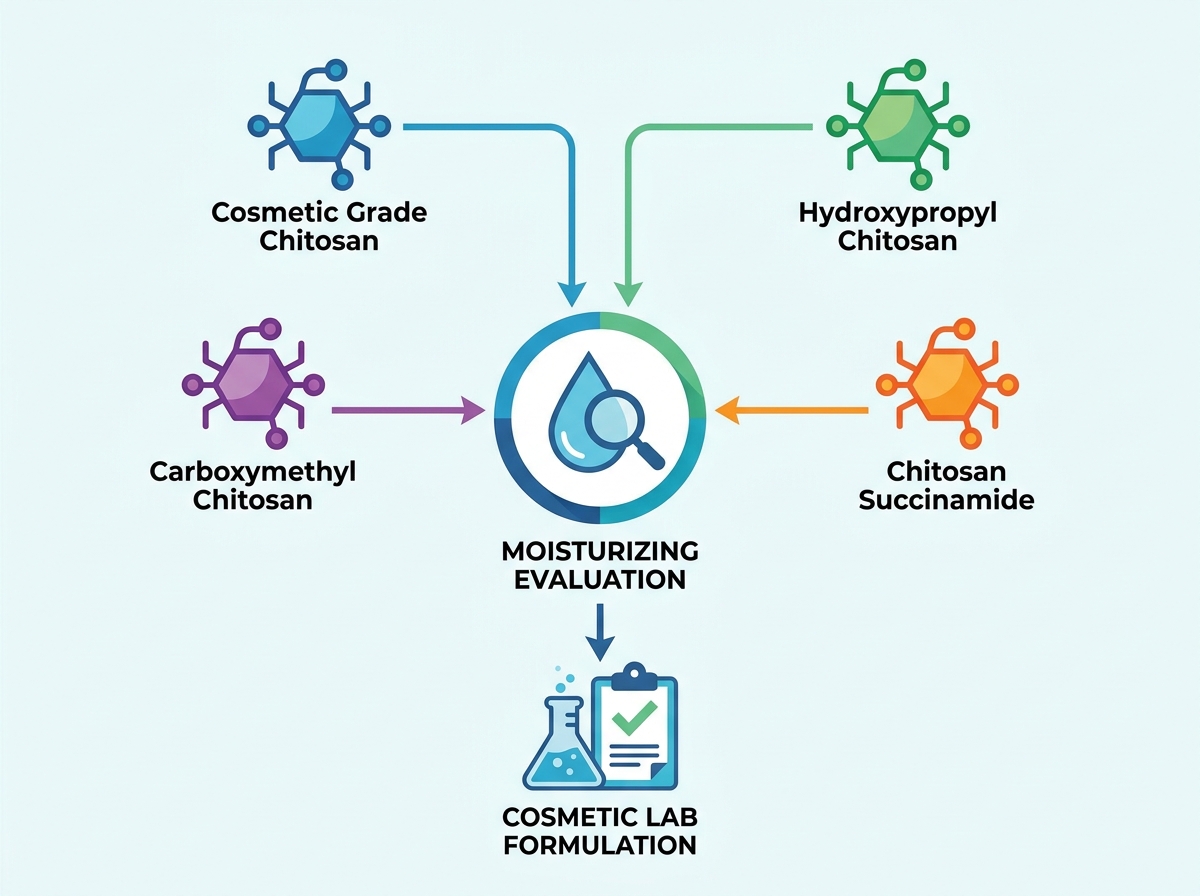
Understanding the pH tolerance of each derivative is the foundation of successful formulation. Compounding unmodified chitosan requires precise titration and temperature control. Failing to control the neutralization process will result in polymer crashing, yielding a gritty, unusable batch that must be discarded.
Standard Operating Procedure for Hydrating Unmodified Chitosan:
Derivative pH Tolerance and Solubility Matrix
| Derivative Type | Optimal pH Range | Solubility Characteristics | Primary Application |
|---|---|---|---|
| Standard Unmodified | 4.0 - 5.5 | Requires acidic activation | Exfoliants, Hair Conditioners |
| Hydroxypropyl | 3.0 - 8.0 | Broad water solubility | Clear Gels, Serums |
| Carboxymethyl | 4.0 - 9.0 | Amphoteric, wide spectrum | Cleansers, Lotions |
| Succinamide | 5.0 - 8.0 | Excellent emulsion stability | Premium Creams, Masks |
The concentration of the polymer directly impacts the viscosity and flow behavior of the final product. High molecular weight variants will rapidly build viscosity, exhibiting pseudoplastic (shear-thinning) rheology. This allows heavy creams to spread easily upon application but recover their structure quickly on the skin, preventing dripping. Formulators must carefully calibrate the concentration, typically between 0.5% and 2.0%, to achieve the desired thickness without creating a stringy or mucilaginous texture that consumers dislike.
Addressing consumer sensory requirements is paramount during the R&D phase. High concentrations of film-forming biopolymers can lead to inherent tackiness during the initial dry-down phase, sometimes resulting in "pilling" (rolling off the skin in small flakes) when layered with other cosmetics or sunscreens. Mitigating this requires precise lipid pairing. Incorporating specific emollients like squalane, medium-chain triglycerides (MCT), or ceramides disrupts the rigid polymer film just enough to eliminate tackiness while preserving the moisture barrier. Selecting a lower molecular weight variant can also reduce surface pilling by enhancing deeper epidermal penetration rather than sitting entirely on the surface.
Combining these biopolymers with other active ingredients requires strategic charge management. Pairing cationic chitosan with strongly anionic hyaluronic acid (HA) can lead to coacervation—a phase separation where the two polymers bind and precipitate out of the serum. However, controlled management of this cationic-anionic interaction can create a highly effective dual-layer hydration system. By utilizing an amphoteric derivative or carefully buffering the pH, formulators can suspend both actives, allowing HA to bind water deep in the epidermis while the biopolymer seals it in at the stratum corneum.
The polymer matrix also offers excellent encapsulation potential for unstable molecules. The structural network can be utilized to stabilize and deliver volatile or easily degraded actives, such as L-ascorbic acid (Vitamin C) or delicate peptides. The film-forming properties slow the oxidation rate of these actives upon exposure to air and control their release kinetics into the skin, extending their functional efficacy over time and preventing the formula from browning in the bottle.
The most common failure point when working with unmodified grades is ionic incompatibility. High-risk combinations include pairing the cationic polymer with strong anionic thickeners like carbomers, xanthan gum, or standard anionic surfactants like sodium lauryl sulfate. When these materials interact, they immediately form insoluble complexes, destroying the formulation's viscosity, texture, and stability.
Mitigation tactics require a fundamental shift in the chassis design. Formulators should utilize non-ionic thickeners such as hydroxyethylcellulose (HEC), hydroxypropyl methylcellulose (HPMC), or polyacrylamide-based rheology modifiers, which do not react with cationic charges. Alternatively, switching the active moisturizing agent to a non-ionic derivative like hydroxypropyl chitosan bypasses these ionic conflicts entirely, allowing the use of traditional anionic thickeners without the risk of precipitation.
Polymer Compatibility Matrix
| Thickener / Polymer Type | Standard Chitosan Compatibility | Modified Derivative Compatibility | Lab Recommendation |
|---|---|---|---|
| Carbomer (Anionic) | Incompatible (Precipitates) | Compatible (Hydroxypropyl) | Avoid with standard grades. |
| Xanthan Gum (Anionic) | Incompatible (Precipitates) | Compatible (Carboxymethyl) | Use non-ionic gums instead. |
| HEC (Non-ionic) | Highly Compatible | Highly Compatible | Primary choice for gel chassis. |
| Polyquaternium-10 (Cationic) | Compatible | Compatible | Excellent for hair care systems. |
The inherent antimicrobial properties of these biopolymers present both an advantage and a risk during formulation. While they can boost the overall microbial stability of a product, they interact unpredictably with standard preservative systems. Cationic environments can deactivate certain anionic preservatives, rendering the system vulnerable to fungal or bacterial contamination over its shelf life.
Formulators must avoid over-preservation. Adding high loads of traditional preservatives to a naturally antimicrobial base can lead to skin sensitization and barrier disruption for the end user. Instead, labs should utilize compatible, broad-spectrum non-ionic preservatives like phenoxyethanol, ethylhexylglycerin, or caprylyl glycol. Rigorous Preservative Efficacy Testing (PET) or micro-challenge testing is mandatory to ensure the preservative system remains active and effective in the presence of the polymer matrix.
Natural marine-derived polymers exhibit inherent batch-to-batch variance. Fluctuations in raw material sourcing can affect the degree of deacetylation and molecular weight distribution, which in turn alters the solubility and viscosity of the final cosmetic product. Relying solely on supplier documentation is insufficient for high-level commercial manufacturing.
Cosmetic labs must establish strict internal testing protocols upon receiving raw materials. Mandating Fourier-transform infrared spectroscopy (FTIR) allows chemists to verify the DDA variance accurately. Viscometry testing on standardized aqueous solutions using a Brookfield viscometer confirms the MW distribution. Cross-referencing these internal analytical results against the supplier's Certificates of Analysis (COAs) ensures that every batch will perform consistently on the production floor, preventing costly scale-up failures.
Procurement teams often face a decision between the economical standard grades and the higher-priced chemically modified derivatives. Carboxymethyl and succinamide variants carry a higher price per kilo due to the complex synthesis required to produce them. Evaluating this cost in isolation ignores the formulation economy and the potential for chassis simplification.
The higher upfront raw material cost is frequently offset by the elimination of secondary ingredients. Because these premium derivatives function simultaneously as primary humectants, film-formers, emulsion stabilizers, and soothing agents, formulators can strip out synthetic thickeners, silicones, and secondary anti-irritants. This consolidation reduces overall inventory complexity, shortens compounding time, and streamlines the manufacturing process, making the premium derivatives highly commercially viable for large-scale production.
Navigating the regulatory landscape requires precise INCI naming conventions. Each derivative holds a distinct INCI name, and regulatory bodies require accurate labeling to substantiate marketing claims. Formulators must ensure that the specific chemical modification used on the bench matches the declared ingredient list perfectly to avoid compliance audits or product recalls.
The marketing value generated by these ingredients provides a strong return on the raw material investment. Claims such as "marine-derived," "biocompatible," "biodegradable," and "clinically proven barrier-repairing" resonate strongly with modern consumers. When backed by the verifiable performance of high-DDA derivatives, these claims elevate the product's market positioning, justifying the use of advanced biopolymer technology in commercial skincare and haircare lines.
To integrate these advanced biopolymers into your commercial manufacturing pipeline, execute the following steps:
A: The ideal molecular weight depends on the target delivery zone. Low molecular weight variants (2-5 kDa) penetrate the upper epidermis for deep internal hydration. High molecular weight variants (>100 kDa) remain on the surface, creating a breathable, moisture-trapping film that effectively reduces Transepidermal Water Loss.
A: Standard chitosan is cationic and only soluble in acidic environments. Carboxymethyl chitosan is amphoteric, meaning it contains both positive and negative charges. This modification grants it excellent water solubility across a much wider pH range (4.0 to 9.0) and prevents precipitation when mixed with anionic surfactants.
A: Yes. The introduction of propylene glycol groups disrupts the polymer's internal hydrogen bonding, granting it non-ionic characteristics and broad water solubility. This allows formulators to create perfectly clear, stable hydration gels and lightweight serums without the turbidity associated with unmodified variants.
A: The primary incompatibility involves mixing unmodified, cationic grades with strong anionic polymers. Combining it with carbomers, xanthan gum, or standard anionic surfactants will cause immediate coacervation and precipitation, ruining the formulation's texture and stability.
A: Yes. Succinylation improves the polymer's solubility and rheological stability across a broader pH spectrum compared to standard grades. It remains highly stable in neutral environments (pH 5.0 to 8.0), making it ideal for premium emulsions, anti-aging creams, and overnight masks.
A: While hyaluronic acid is an exceptional humectant that binds water, it lacks strong occlusive properties. Chitosan acts as both a humectant and a superior film-former. It creates a physical, breathable biopolymer matrix on the stratum corneum that actively seals in moisture, providing a more robust reduction in TEWL.
A: In skin care, it forms a hydrating, breathable barrier. In hair care, its cationic charge allows it to bind directly to the negatively charged, damaged sites of keratin. It smooths the hair cuticle, reduces static, and locks in internal moisture, making it highly effective for restorative conditioners and leave-in treatments.


