

close
Choose Your Site
Global
Social Media
Views: 0 Author: Site Editor Publish Time: 2026-07-20 Origin: Site


Formulating water-based cosmetics presents a persistent hurdle when integrating natural polymers. Native cosmetic grade chitosan offers exceptional biocompatibility and film-forming properties, but its reliance on dilute acidic solutions (pH < 6.0) severely limits its application in modern, pH-neutral formulas. This acidic requirement restricts compatibility with pH-sensitive active ingredients and neutral-to-alkaline cosmetic bases.
Cosmetic chemists require multifunctional polymers that deliver hydration and rheology control without compromising formula stability, clarity, or sensory profile when interacting with diverse active ingredients and ionic systems. The solution lies in chemical modification. Specifically, the addition of hydroxypropyl groups serves as the technical bridge, transforming the polymer's behavior in aqueous environments.
This technical evaluation compares hydroxypropyl chitosan against other derivatives within the broader Cosmetic Raw Material Chitosan Series to help formulators make evidence-based procurement and formulation decisions.
Unrestricted Solubility: Hydroxypropyl chitosan with a Degree of Substitution (DS) ≥ 0.40 achieves complete water solubility across a broad pH range (1–13), eliminating the need for acidic protonation.
Derivative Selection: While hydroxypropyl chitosan excels in broad pH compatibility and non-ionic/weakly cationic stability, formulators must weigh it against other options in the cosmetic raw material chitosan series—such as carboxymethyl chitosan, chitosan succinamide, or chitosan hydrochloride—based on charge density and formulation requirements.
Active Delivery & Permeation: Low molecular weight fractions of hydroxypropyl chitosan do not just form films; they significantly enhance the penetration of active ingredients into the stratum corneum and provide auxiliary antimicrobial defense against Gram-negative bacteria.
Clean Beauty & Safety Profile: With an EWG green-light safety rating of 1, high biodegradability, and zero toxicity, hydroxypropyl chitosan cosmetics align perfectly with global sustainability and clean label formulation standards.
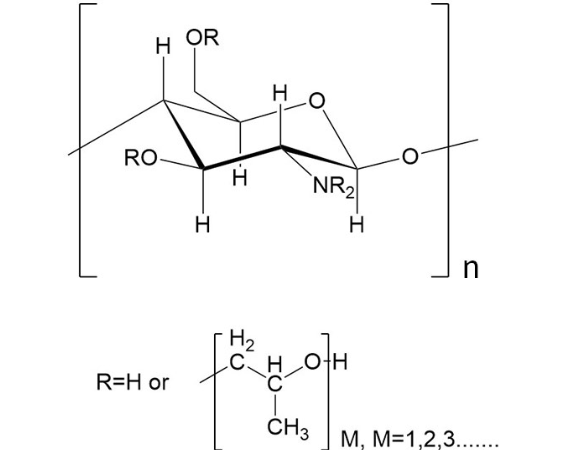
The molecular structure of native chitosan dictates its solubility profile. It relies heavily on the protonation of primary amino groups to dissolve. This structural characteristic necessitates maintaining a formulation pH below 6.0. Such a constraint restricts compatibility with pH-sensitive actives and neutral-to-alkaline cosmetic bases, complicating formulation efforts for modern skincare products. When you attempt to push the pH above 6.5, native chitosan rapidly deprotonates. This leads to immediate precipitation, turning a clear serum into a cloudy, unusable suspension. Formulators often spend hours trying to buffer these systems, only to find that the active ingredients degrade in the acidic environment required to keep the polymer in solution.
We see this constantly in the lab when working with niacinamide or certain peptide complexes. These actives demand a pH closer to 6.0 or 7.0 for optimal stability. Forcing them into a low-pH chitosan base either destroys the active or crashes the polymer. You cannot build a robust, multi-active serum when your primary film-former dictates such a narrow, acidic operating window.
Chitosan Hydrochloride serves as a traditional, water-soluble salt alternative. It dissolves easily in water without the need for added acids. However, it presents notable shortcomings in complex formulations. It exhibits high ionic sensitivity and a tendency to drift formulation pH downward over time. Furthermore, it possesses the potential to cause instability or precipitation when integrated into complex surfactant bases, limiting its versatility.
If you add a standard anionic thickener to a chitosan hydrochloride solution, you will likely observe immediate coacervation. The strong positive charge of the hydrochloride salt interacts aggressively with anionic species. This creates stringy, insoluble complexes that ruin the batch. It forces formulators to rely exclusively on non-ionic or cationic emulsifiers and thickeners, severely limiting the formulation toolkit.
The synthesis process involves the reaction of chitosan with propylene oxide to introduce hydroxypropyl groups. This structural modification disrupts the intermolecular hydrogen bonding inherent in the crystalline structure of native chitosan. The outcome unlocks true water solubility while maintaining the polymer's essential biodegradability and biocompatibility.
By attaching these bulky hydroxypropyl groups to the polymer backbone, we physically prevent the polymer chains from packing tightly together. This steric hindrance keeps the material amorphous and highly soluble in water, regardless of the pH. You get the film-forming and hydrating benefits of the chitosan backbone without the restrictive solubility rules.
| Polymer Type | Solubility pH Range | Ionic Character | Formulation Compatibility |
|---|---|---|---|
| Native Chitosan | pH < 6.0 | Cationic | Low (Precipitates in neutral bases) |
| Chitosan Hydrochloride | pH 2.0 - 7.0 | Strongly Cationic | Moderate (Incompatible with anionics) |
| Hydroxypropyl Chitosan | pH 1.0 - 13.0 | Non-ionic / Weakly Cationic | High (Broad compatibility) |
The critical metric for evaluating this derivative is the Degree of Substitution (DS). A DS of ≥ 0.40 stands as the industry standard for cosmetic applications. Performance data indicates that meeting this threshold ensures the ability to maintain clear, stable solutions across extreme pH ranges (pH 1–13) without precipitation. If you source a batch with a DS of 0.25, you will notice incomplete hydration and a hazy appearance in the final product.
When formulating hydroxypropyl chitosan cosmetics, verifying the DS on the Certificate of Analysis is your first line of defense against batch failure. A high DS guarantees that the polymer will not crash out when you adjust the final pH with citric acid or sodium hydroxide. It provides a massive safety margin during scale-up manufacturing.
As a thickening agent, its behavior depends heavily on molecular weight, which dictates the resulting viscosity profiles in water-based serums and gels. It offers favorable shear-thinning properties and a positive sensory impact, effectively avoiding the tacky or stringy feel common with some high-molecular-weight polysaccharides. You can build a serum that pumps easily but stays on the skin without dripping.
Disperse the polymer powder slowly into the vortex of room-temperature water.
Maintain high-shear mixing for 15-20 minutes to ensure complete hydration.
Allow the solution to rest to release entrapped air bubbles before adding active ingredients.
Adjust the final viscosity using compatible co-thickeners if a stiffer gel is required.
Low molecular weight (LMW) hydroxypropyl chitosan plays a crucial role in advanced formulations. LMW derivatives act as penetration enhancers. They facilitate the cellular-level incorporation and delivery of water-soluble actives, enhancing overall product efficacy. The polymer temporarily modifies the stratum corneum barrier, allowing smaller active molecules to pass through more efficiently.
We utilize this property extensively in vitamin C and peptide serums. Instead of the active sitting on the surface of the skin, the LMW polymer matrix helps drive it deeper. This results in better clinical outcomes for the end user without requiring harsh chemical penetration enhancers like propylene glycol or ethanol.
The polymer matrix forms a breathable, occlusive film on the stratum corneum, providing excellent barrier properties. It demonstrates superior moisture-absorption and moisture-retention capacities when compared against traditional humectants like hyaluronic acid and glycerin under varying relative humidity conditions. It does not draw water from the deeper layers of the skin in dry climates.
This film-forming action is entirely non-tacky. Consumers often complain about the sticky finish left by high doses of glycerin or certain grades of hyaluronic acid. Hydroxypropyl chitosan dries down to a smooth, imperceptible shield that locks in hydration while providing a smooth canvas for makeup application.
The chitosan backbone retains inherent biological activity. It exhibits an inhibitory effect on Gram-negative bacteria. This characteristic offers synergistic support to standard cosmetic preservative systems, enhancing product longevity and safety. You can often reduce the total preservative load in the formula when utilizing this polymer.
While it cannot replace a broad-spectrum preservative system, it acts as a reliable hurdle in your preservation strategy. It is particularly effective in water-heavy formulations that are highly susceptible to microbial contamination during consumer use.
Consumer safety remains a paramount concern. This derivative boasts an exceptionally low hazard profile, reflected in an EWG rating of 1. It provides significant cosmetic compliance advantages, being non-irritating, completely biodegradable, non-toxic, and harmless to aquatic life. It washes off the skin and breaks down naturally in wastewater systems.
Evaluating the ionic nature is essential. Hydroxypropyl variants exhibit non-ionic or weakly cationic behavior, whereas carboxymethyl chitosan cosmetics are amphoteric or anionic. Formulators should specify carboxymethyl for specific anionic compatibility, while hydroxypropyl is preferred for broader pH stability and distinct sensory elegance.
If your base relies heavily on anionic emulsifiers or thickeners like carbomer, carboxymethyl chitosan is the safer choice to prevent coacervation. However, if you are building a non-ionic serum or a weakly cationic hair conditioner, hydroxypropyl chitosan will deliver superior film-forming and conditioning properties without the risk of phase separation.
Chitosan succinamide represents another highly soluble derivative within the series. It offers excellent film-forming flexibility and a refined skin-feel. Formulators often compare its performance against hydroxypropyl variants when developing targeted anti-aging or barrier-repair formulations.
We often select succinamide variants when formulating under-eye gels or tightening serums. The specific structural modification provides a slight mechanical tightening effect on the skin as the water evaporates. It is a specialized tool within the series, whereas hydroxypropyl remains the versatile workhorse for general hydration and active delivery.
Chitosan Hydrochloride relies on ionic, salt-based solubility, contrasting sharply with the covalent, ether-linked non-ionic solubility of Hydroxypropyl Chitosan. This structural difference explains why Hydroxypropyl Chitosan provides superior compatibility with non-ionic and cationic emulsifiers without causing viscosity drops over time.
When you add salt (sodium chloride) to a chitosan hydrochloride solution, the viscosity often plummets due to charge shielding. Hydroxypropyl chitosan, being largely non-ionic, is highly salt-tolerant. You can incorporate botanical extracts that naturally contain high salt levels without destroying the rheology of your serum.
Establishing criteria for raw material selection requires attention to molecular weight distribution, DS verification, ash content, and microbiological purity. Formulators must balance the higher raw material cost of modified derivatives against the reduction in required co-thickeners and synthetic film-formers to optimize the cost-to-performance ratio.
Verify the Degree of Substitution (DS) is ≥ 0.40 on every batch.
Check the ash content; it should be below 1.0% to ensure clarity in water-based serums.
Request molecular weight specifications to ensure consistent viscosity building.
Confirm the microbiological purity, specifically the absence of heavy metals and pathogens.
The primary formulation risk involves the potential for insoluble complex formation (coacervation) when mixing cationic-leaning chitosan derivatives with strong anionic surfactants (e.g., SLS, SLES) or anionic carbomers. Mitigation strategies include careful sequencing of addition, utilizing non-ionic or amphoteric surfactant systems, and leveraging compatible rheology modifiers like hydroxyethylcellulose.
If you must use an anionic system, always hydrate the hydroxypropyl chitosan separately. Add it to the main batch only after the anionic components are fully neutralized and diluted. Even then, conduct rigorous stability testing at elevated temperatures to ensure no delayed precipitation occurs over a 12-week period.
Natural polymer solutions remain vulnerable to microbial degradation despite their inherent antimicrobial properties. Formulators must evaluate and select compatible preservative systems that do not compromise the stability, clarity, or ionic charge of the hydroxypropyl chitosan matrix.
Avoid preservatives that rely on strong anionic charges or those that cause significant pH shifts upon addition. Phenoxyethanol combined with ethylhexylglycerin generally performs well. Always conduct a full USP 51 Antimicrobial Effectiveness Test (AET) on the final formulation, as polysaccharides can sometimes bind to preservatives, reducing their free concentration and efficacy.
Inconsistent Degree of Substitution (DS) or molecular weight from suppliers poses significant risks. Implementing strict Quality Assurance (QA) protocols is vital. Formulators should require detailed Certificates of Analysis (CoA) specifically detailing DS, viscosity in a standard solution, and pH stability limits.
Do not accept generic CoAs that only list "appearance" and "moisture content." You need hard data on the substitution levels. A drop in DS from 0.45 to 0.30 between batches will completely alter the solubility and sensory profile of your finished cosmetic product, leading to costly manufacturing rejections.
Request raw material samples with a verified Degree of Substitution (DS) of 0.40 or higher.
Conduct immediate knock-out testing by mixing the polymer with your existing anionic thickeners to check for coacervation.
Formulate a base serum using non-ionic thickeners like hydroxyethylcellulose to establish a stable baseline.
Initiate 12-week accelerated stability testing at 45°C to monitor viscosity and clarity.
A: Native chitosan requires an acidic environment (pH < 6.0) to dissolve, whereas hydroxypropyl chitosan is chemically modified to be completely water-soluble across a wide pH range (1-13) without requiring acids.
A: For complete water solubility and optimal moisture retention in cosmetic formulations, a Degree of Substitution (DS) of 0.40 or higher is required.
A: Chitosan Hydrochloride is a water-soluble ionic salt that remains sensitive to pH shifts and ionic surfactants. Hydroxypropyl Chitosan is covalently modified to offer non-ionic behavior, rendering it far more stable in complex, multi-ingredient cosmetic bases.
A: It requires careful formulation. Because chitosan derivatives can exhibit cationic behavior, combining them directly with strong anionic polymers like Carbomer can lead to precipitation or coacervation. Compatibility testing is mandatory.
A: Hydroxypropyl chitosan boasts an exceptionally low hazard profile, holding an EWG safety rating of 1. It is completely biodegradable, non-toxic, and harmless to aquatic life, aligning well with clean beauty standards.


