

close
Choose Your Site
Global
Social Media
Views: 0 Author: Site Editor Publish Time: 2026-08-18 Origin: Site


The transition toward biocompatible, marine-derived polymers has positioned modified chitosan as a critical structural and functional ingredient in advanced skincare and haircare formulations. Native chitosan suffers from poor aqueous solubility at neutral pH, severely limiting its direct application in cosmetics. While chemical modification resolves this, the specific processing steps utilized by suppliers dictate the final polymer’s purity, batch-to-batch consistency, and regulatory viability. Formulators and procurement teams face the challenge of vetting these synthesis pathways to avoid formulation instability or safety compliance failures.
Understanding the standardized manufacturing protocols for hydroxypropyl chitosan—and how it compares to other derivatives within the broader Cosmetic Raw Material Chitosan Series—enables R&D and procurement teams to establish rigorous technical specifications, mitigate scale-up risks, and select the optimal polymer for specific formulation architectures.
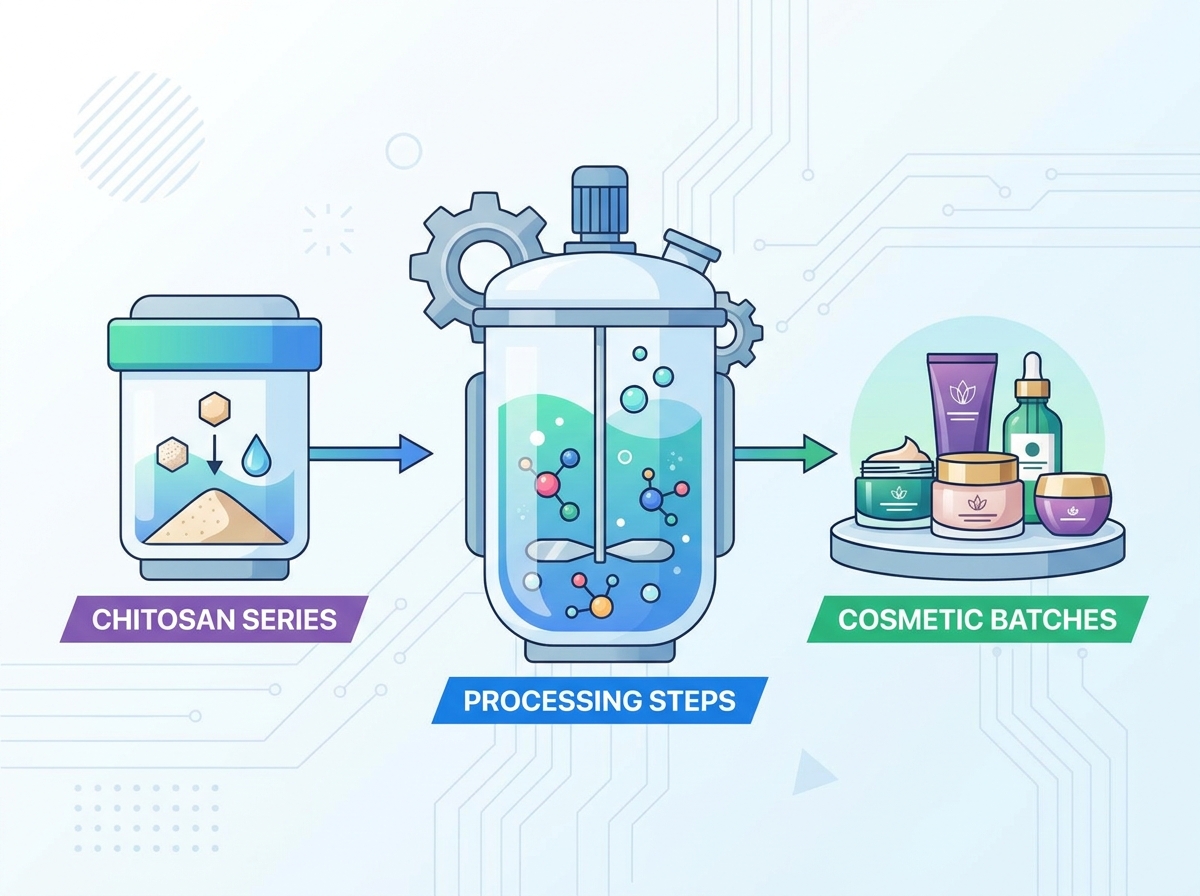
Integrating chitosan into cosmetic matrices requires overcoming inherent chemical limitations on the compounding floor. Native chitosan remains completely insoluble in water unless the pH drops below 6.0, typically requiring the addition of acetic, lactic, or hydrochloric acid. Cosmetic products, particularly daily-use emulsions and serums, demand a neutral or slightly acidic pH profile (around 5.0 to 6.5) to maintain human skin barrier integrity. Formulators need a polymer that dissolves readily in standard deionized water phases without requiring harsh organic acids that destabilize other active ingredients.
The baseline success criteria for these modified polymers include complete aqueous solubility at room temperature, high biocompatibility, and robust film-forming capabilities. When added to a mixing vessel, the modified polymer must hydrate uniformly without forming "fish-eyes" or agglomerations. Furthermore, it must integrate seamlessly into the continuous phase without disrupting emulsion stability or causing unwanted coacervation when combined with standard cosmetic surfactants, rheology modifiers, and preservatives.
Sustainability drives modern cosmetic chemistry, and raw material selection dictates the final product's environmental footprint. The strategic addition of hydroxypropyl groups to the chitosan backbone alters its physical properties while preserving its ecological profile. This specific etherification process ensures the resulting polymer remains fully biodegradable under standard OECD 301 testing protocols. It breaks down naturally in aquatic environments via enzymatic degradation, ensuring it does not contribute to the growing microplastic pollution crisis.
The modified structure remains highly biocompatible and harmless to human tissue, exhibiting zero cytotoxicity in standard dermal patch tests. By utilizing controlled etherification, manufacturers achieve the critical water solubility required for commercial-scale manufacturing without sacrificing the natural, eco-friendly claims that consumers demand from marine-derived ingredients. This balance allows brands to replace synthetic film-formers like PVP or certain polyacrylates with a sustainable marine alternative.
The personal care industry relies on several primary modified chitosan derivatives, each undergoing specific chemical alterations to fulfill distinct functional roles in a formulation architecture. Understanding these categories allows chemists to select the exact polymer needed for a specific product brief.
Specific chemical modifications directly alter the polymer's behavior in a formulation. Evaluating these dimensions helps formulators map structural features to desired clinical outcomes on the bench.
The synthesis of hydroxypropyl chitosan cosmetics begins with the precise dispersion of raw chitosan flake or powder. Manufacturers typically select raw material with a deacetylation degree of 85% or higher to ensure sufficient reactive amino sites. The chitosan powder is suspended in a carefully calibrated solvent matrix within a jacketed stainless-steel reactor. Industry standards utilize a specific weight ratio of isopropanol and distilled water, often hovering around an 80:20 or 85:15 ratio. Isopropanol acts as a swelling agent rather than a true solvent. It opens the dense crystalline structure of the polymer without causing premature dissolution, maintaining a workable solid-liquid slurry. This phase preparation is critical for ensuring uniform reagent penetration.
Alkalization follows the initial dispersion. Sodium hydroxide (NaOH) is introduced slowly, specifically targeting a critical concentration range of 30% to 50% within the aqueous phase. This precise alkali concentration disrupts the extensive intra-molecular and inter-molecular hydrogen bonding within the chitosan matrix. Operators must maintain reactor temperatures strictly between 15°C and 20°C during this phase. The alkaline environment activates the hydroxyl and amino groups on the glucosamine units, preparing the backbone for the upcoming etherification reaction.
Procurement teams must evaluate how suppliers manage this alkalization phase. Variations in temperature control or alkali concentration lead to unwanted polymer chain degradation. Excessive heat or prolonged exposure to high NaOH concentrations causes rapid chain scission, drastically lowering the molecular weight. A compromised molecular weight reduces the polymer's viscosity yield and diminishes its film-forming efficacy in the final cosmetic emulsion.
Etherification transforms the alkalized intermediate into a highly functional, water-soluble polymer. Propylene oxide is introduced into the pressurized reaction vessel under strictly controlled conditions. The epoxide ring of the propylene oxide opens and reacts with the activated functional groups on the chitosan backbone. This nucleophilic substitution attaches hydroxypropyl groups via stable ether linkages. The reaction occurs primarily at the C-6 hydroxyl group and the C-2 amino group, depending on the specific reaction kinetics, temperature ramps, and steric hindrance.
Several critical reaction parameters govern the success of this phase on the factory floor. Reaction time, internal vessel temperature (typically ramped to 40°C–60°C), and the exact molar ratio of propylene oxide to glucosamine units must be tightly regulated. Propylene oxide is highly volatile and flammable, requiring specialized pressurized reactors equipped with robust cooling jackets to maintain the necessary liquid-phase concentration and manage the exothermic reaction. Adjusting these variables allows chemical engineers to control the reaction rate and prevent the formation of unwanted byproducts, such as propylene glycol homopolymers.
The primary supplier evaluation point during etherification is the control over the Degree of Substitution (DS). The DS represents the average number of hydroxypropyl groups attached to each monomer unit. A higher DS significantly increases water solubility and flexibility. However, over-substitution alters the tactile profile, making the final cosmetic formulation feel excessively tacky, stringy, or heavy on the skin. Suppliers must demonstrate the statistical process control necessary to hit narrow DS target ranges consistently across multiple metric-ton batches.
Once the desired degree of substitution is achieved, the etherification reaction must be terminated immediately to prevent over-reaction. Manufacturers neutralize the highly alkaline mixture using organic or inorganic acids, frequently employing glacial acetic acid or hydrochloric acid until the slurry reaches a pH of 7.0 to 7.5. Neutralization halts further chemical modification and stabilizes the polymer chain. The resulting crude product contains the modified polymer alongside unreacted reagents, neutralized sodium salts, and heavy solvent residues.
Exhaustive purification is the defining step for achieving cosmetic grade chitosan status. The crude polymer undergoes multiple rigorous washing phases in industrial centrifuges or filter presses, typically utilizing 70% to 80% ethanol mixtures. These washes extract residual propylene oxide, toxic glycols, and excess salts. The washing process must be repeated—often three to five times—until the effluent meets stringent purity parameters measured via gas chromatography.
Inadequate washing leaves volatile organic compounds that cause severe skin irritation, destabilize cosmetic emulsions, or trigger regulatory recalls. Suppliers must provide transparent Certificate of Analysis (CoA) reporting for every lot. Formulators should demand precise quantification of residual solvents and monomer limits. Cosmetic regulations strictly cap the allowable levels of free propylene oxide due to its hazardous classification, often requiring levels below 1 ppm. A robust, verifiable purification protocol is non-negotiable for ensuring consumer safety.
The purified wet cake moves to the drying phase. Vacuum drying at controlled temperatures (50°C to 60°C) is the preferred industrial method. It removes residual ethanol and water without exposing the polymer to oxidative stress, preventing thermal degradation or unwanted color changes (browning) in the final powder. Standard convection drying often exposes the polymer to excessive heat, which causes late-stage chain scission, cross-linking, and a subsequent loss of solubility.
Following desiccation, the polymer undergoes mechanical milling—often using pin mills or jet mills—to achieve a uniform powder. Particle size distribution directly impacts the hydration rate on the cosmetic compounding floor. A finely milled powder (typically passing through an 80 to 120 mesh screen) with a narrow particle size distribution disperses efficiently in commercial manufacturing vessels. Coarse particles lead to clumps of unhydrated polymer encased in a gel layer. Resolving these clumps requires excessive high-shear mixing, which generates unwanted heat and potentially damages other sensitive active ingredients in the batch.
Fourier-transform infrared spectroscopy (FT-IR) serves as the frontline analytical tool for structural verification in the QA lab. FT-IR confirms the successful attachment of hydroxypropyl functional groups to the chitosan backbone. Technicians look for specific absorption bands, such as the enhanced C-H stretching vibrations around 2870 cm⁻¹ and 2930 cm⁻¹, alongside the characteristic ether bond (C-O-C) signals near 1070 cm⁻¹. This spectral fingerprint ensures the etherification reaction proceeded correctly and definitively distinguishes the modified derivative from native chitosan.
Nuclear Magnetic Resonance (1H NMR) provides precise quantitative data. Using D2O as a solvent, NMR analysis accurately calculates the degree of substitution (DS) and the degree of deacetylation (DDA). By integrating the proton signals from the newly attached hydroxypropyl groups against the baseline signals from the glucosamine backbone, chemists determine the exact chemical composition of the batch. This data is critical for predicting the polymer's solubility, charge density, and interaction potential with cosmetic surfactants.
Rheological testing establishes the baseline viscosity profiles in aqueous solutions. Technicians measure the flow behavior of a 1% aqueous solution at 20°C using Brookfield viscometers under varying shear rates. Consistent rheology is vital for thickeners and film-formers. If the viscosity fluctuates wildly between batches, the final cosmetic emulsion suffers from instability, phase separation, or altered sensory characteristics that consumers will immediately notice.
Comprehensive chemical analysis accelerates New Product Development (NPD). When R&D teams possess accurate structural and rheological data, they confidently prototype new cosmetic lines. Verified structural data eliminates formulation guesswork. It allows chemists to predict polymer behavior, optimize surfactant ratios quickly, and reduce the overall time-to-market for advanced personal care products.
Cosmetic raw materials must adhere to strict purity thresholds enforced by global regulatory bodies. Suppliers must define and enforce acceptable limits for heavy metals, including lead (Pb < 10 ppm), arsenic (As < 2 ppm), mercury (Hg < 1 ppm), and cadmium (Cd < 1 ppm). Marine-derived polymers carry an inherent risk of heavy metal accumulation from ocean environments, making rigorous atomic absorption spectroscopy testing mandatory for every commercial lot.
Microbial contamination limits are equally critical for materials used in water-rich cosmetic emulsions. Batches must pass tests for Total Plate Count (< 100 CFU/g), Yeast and Mold (< 50 CFU/g), and confirm the absolute absence of specific pathogens like Staphylococcus aureus, Pseudomonas aeruginosa, and E. coli. Navigating global cosmetic regulations requires meticulous documentation. The manufacturing process must align with the EU Cosmetics Regulation (EC No 1223/2009) and FDA guidelines for raw materials. Proper INCI registration ensures the ingredient can be legally marketed and listed on consumer packaging.
Chitosan Derivative Functional Comparison
| Derivative Type | Ionic Nature | Primary Cosmetic Function | Formulation Compatibility |
|---|---|---|---|
| Hydroxypropyl Chitosan | Non-ionic | Film-forming, broad-spectrum thickening | High compatibility with most surfactants across a wide pH range. |
| Carboxymethyl Chitosan | Amphoteric / Anionic | Moisture retention, heavy metal chelation | pH sensitive; requires careful balancing with cationic ingredients. |
| Chitosan Succinamide | Anionic / Substantive | Hair cuticle repair, targeted conditioning | Excellent for specialized hair care matrices; binds to damaged keratin. |
| Chitosan Hydrochloride | Strongly Cationic | Antimicrobial preservation, strong adhesion | Prone to precipitation with anionic thickeners (e.g., carbomers). |
The chemical differences between these two derivatives dictate their formulation pathways on the bench. Hydroxypropyl chitosan is primarily non-ionic. This lack of strong electrical charge prevents unwanted interactions with charged emulsifiers, making it highly versatile for standard lotions and creams. In contrast, carboxymethyl chitosan cosmetics exhibit amphoteric or anionic behavior depending on the formulation's final pH. The introduction of carboxylic groups creates a polymer that responds dynamically to its chemical environment.
Formulators must evaluate solubility and performance across different pH spectrums. Carboxymethyl variants offer superior moisture retention at specific pH levels. The charged groups bind water molecules tightly, creating a hydrating matrix ideal for anti-aging serums, hydrogels, and intensive moisturizers. However, hydroxypropyl variants provide broader compatibility with complex, multi-surfactant systems. If a formulation contains a mix of non-ionic and mild anionic surfactants, hydroxypropyl chitosan presents a significantly lower risk of phase separation over the product's shelf life.
Chitosan succinamide offers specific, highly targeted utility in hair care applications. The unique succinyl groups introduced during modification enhance the polymer's affinity for damaged, negatively charged keratin sites on the hair shaft. It provides exceptional damage repair and conditioning properties. Compared to the flexible film-forming nature of hydroxypropyl variants, succinamide derivatives create a substantive coating that resists wash-off, effectively sealing split ends and reducing combing friction in wet hair.
Chitosan hydrochloride represents the highly cationic end of the spectrum. It boasts strong antimicrobial properties and excellent adhesion to biological surfaces. However, this high cationic charge creates significant formulation challenges. Hydrochloride forms frequently exhibit severe incompatibility with common anionic thickeners like carbomers or xanthan gum, leading to immediate precipitation, cloudiness, or coacervation in the mixing vessel. Hydroxypropyl chitosan remains the more formulation-friendly option for general skincare emulsions where antimicrobial action is secondary to physical stability and sensory texture.
Natural variations in the source material pose a significant risk to manufacturing consistency. Chitosan is derived from crustacean shells (shrimp, crab) or fungal mycelium. Factors such as species, harvest season, and environmental conditions lead to fluctuating molecular weights and varying baseline deacetylation degrees in the raw chitin. These raw material inconsistencies cascade through the modification process, resulting in final polymers with unpredictable viscosity, solubility profiles, and color variations.
Mitigating this risk requires strict procurement protocols and robust incoming quality control.
Unanticipated precipitation or coacervation remains a primary risk when integrating modified polymers into complex cosmetic bases. Combining chitosan derivatives with strongly anionic emulsifiers (like Sodium Lauryl Sulfate) or specific synthetic rheology modifiers (like cross-linked polyacrylates) triggers immediate phase separation, turning a smooth emulsion into a cottage-cheese-like texture. Even non-ionic variants like hydroxypropyl chitosan interact unexpectedly if residual charges remain from incomplete modification or inadequate purification.
Common Formulation Troubleshooting
| Observed Issue | Probable Cause | Formulation Adjustment |
|---|---|---|
| Immediate precipitation upon mixing | Strong anionic/cationic interaction | Switch to non-ionic or amphoteric co-emulsifiers; check polymer charge. |
| "Fish-eyes" or gel lumps in water phase | Poor dispersion / rapid hydration | Pre-disperse powder in glycerin or glycol before adding to water; increase agitation. |
| Loss of viscosity over time | Polymer chain degradation | Check formulation pH; avoid prolonged high-shear mixing or excessive heat during compounding. |
| Cloudiness in clear serums | Incomplete solubility / low DS | Verify the Degree of Substitution with the supplier; ensure pH is within the soluble range. |
Accelerated stability testing is critical during the R&D phase. Formulators must subject prototypes to extreme freeze-thaw cycles and high-temperature incubation (typically 40°C to 45°C for up to 12 weeks). Adjusting the order of addition during the compounding phase—such as fully hydrating the polymer in a dedicated water phase before introducing any surfactants—prevents localized high-concentration interactions that lead to clumping.
A: A degree of substitution (DS) between 0.4 and 0.8 is typically ideal for cosmetics. This specific range ensures complete water solubility at neutral pH while maintaining the polymer's structural integrity, biocompatibility, and optimal film-forming properties without causing excessive tackiness on the skin.
A: Cosmetic grade purity is achieved through exhaustive post-etherification washing, often utilizing ethanol or aqueous alcohol mixtures. This is followed by controlled vacuum drying. These steps ensure residual propylene oxide, heavy metals, and unreacted alkali fall well below strict regulatory safety thresholds.
A: While hydroxypropyl chitosan is significantly more compatible than native or highly cationic chitosan derivatives, it can still interact with strong anionic surfactants. It is best formulated with non-ionic, amphoteric, or carefully balanced mild anionic systems to prevent unwanted precipitation or coacervation.
A: Hydroxypropyl chitosan is modified via etherification to create a primarily non-ionic, water-soluble polymer with broad pH stability. Carboxymethyl chitosan introduces carboxylic groups, making it amphoteric or anionic. This structural change alters its moisture-binding capacity and interaction potential with other charged cosmetic ingredients.
A: Isopropanol acts as a highly effective dispersing medium. It swells the crystalline chitosan polymer chains without dissolving them. This solid-liquid phase environment allows the 30-50% alkali and propylene oxide reagents to penetrate evenly, ensuring a uniform degree of substitution across the entire batch.
A: Chitosan succinamide is highly valued in advanced hair care formulations. Its unique succinyl modification provides exceptional substantivity to damaged keratin. It offers superior conditioning, cuticle smoothing, and split-end repair capabilities compared to standard hydroxypropyl or native chitosan variants.


